China to Australia Shipping Guide 2026: Freight, Customs, Warehousing & Delivery
Understand shipping from China to Australia, from supplier coordination and freight selection to customs, warehousing and final B2B delivery.
Guide Overview
- Shipping Modes
- Sea Freight / Air Freight
- Main Topics
- Process, Documents, Customs, Delivery
Shipping from China to Australia involves coordinating suppliers, preparing and checking cargo in China, selecting sea freight, air freight or an appropriate small-shipment option, completing export and Australian import requirements, and arranging warehousing or final delivery. The right sequence depends on the cargo’s volume, urgency, product requirements, supplier count and destination needs. For B2B importers, the key is to plan these stages as one connected shipment rather than treating factory pickup, international freight, customs and Australian delivery as separate decisions.
Key Takeaways
- The right transport method depends on cargo profile, urgency and destination requirements—not one factor alone.
- China-side supplier coordination and cargo preparation affect later freight, customs and delivery stages.
- Australian customs and biosecurity requirements depend on the actual goods and should be checked before departure.
- An Australian warehouse can provide a destination control point, but it is not required for every shipment.
- Multi-supplier cargo needs clear traceability before it is consolidated into one coordinated shipping plan.
How Does Shipping from China to Australia Work?
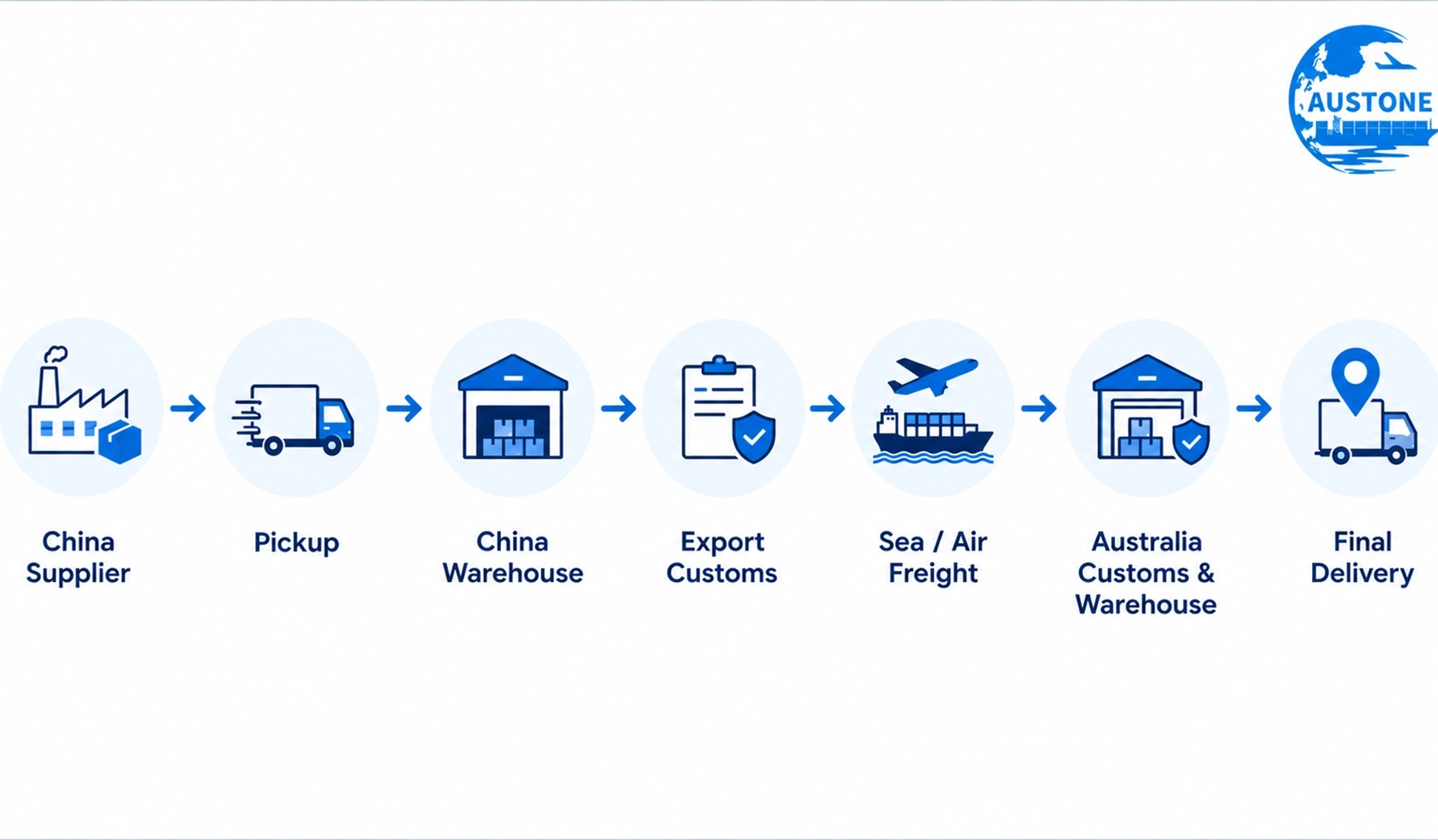
The end-to-end process can be mapped as:
China Supplier → Pickup / Supplier Coordination → China Warehouse → Export Preparation → Sea / Air Freight → Australia Customs Clearance → Australia Warehouse (when required) → Final Delivery
Each shipment may use a different combination of these stages, but the handovers need to connect. Information supplied by the factory affects warehouse receiving and export preparation; the cargo and delivery objective affect the freight method; and customs release affects when Australian warehousing or final delivery can proceed.
Supplier Readiness and Pickup Coordination
The process begins before cargo moves. Importers need to know which supplier is ready, what each factory will hand over, who is responsible for pickup and whether several suppliers must be coordinated.
For one supplier, this may be a straightforward collection. For multiple factories, readiness dates, packing information, carton identification and delivery into the China warehouse need to remain traceable. A combined shipment is easier to control when each batch can still be connected to its source supplier.
China Warehouse Checks and Export Preparation
A China warehouse can provide a control point between the suppliers and international freight. Based on Austone’s confirmed operating material, cargo may be pre-advised, labelled with its pre-advice reference, collected or delivered to the warehouse, scanned, checked and received.
The exact inspection scope should be agreed. A receiving check can identify visible carton or label issues, but it should not be confused with a full product-quality inspection unless that work has been specifically arranged.
Export preparation then connects the physical cargo to the transport plan. Accurate cargo descriptions, quantities, dimensions, weights, packaging and shipment documents matter because later handling and declarations rely on this information.
International Freight Movement
Sea freight and air freight are the main methods for commercial China-to-Australia cargo. Express or small-shipment options may also be considered for samples, documents, spare parts or small urgent consignments.
The international movement is only one part of the result. A vessel or aircraft arrival does not mean the goods have completed Australian clearance or reached the warehouse, project site, store, Amazon fulfilment centre or other final destination.
Australian Customs and Biosecurity Clearance
Imported goods must follow the applicable Australian import process. The importer should confirm the commercial and packing information, product description, classification, importer details and customs-broker responsibilities before cargo departs.
Biosecurity conditions are product-specific. The Department of Agriculture, Fisheries and Forestry advises importers to use BICON to check whether the goods are permitted and whether documents, treatment or an import permit may be required. The correct approach is to check the actual goods and origin rather than apply one compliance assumption to every shipment.
Warehouse Handoff and Final Delivery
After release, cargo may move directly to its delivery destination or enter an Australian warehouse first. A warehouse-first route can support receiving checks, storage, inventory management, order processing, relabelling and scheduled outbound delivery where those functions are needed.
Other shipments may be ready for direct delivery after clearance. The decision should reflect the cargo, delivery channel and required destination handling—not a rule that every shipment must pass through a warehouse.
Choosing the Right Shipping Method from China to Australia
The best shipping method is the one that fits the cargo and business requirement. Importers should compare volume, physical profile, urgency, cargo value, shipment regularity and the destination handoff.
| Method | Commonly Considered For | Main Planning Questions |
|---|---|---|
| Sea freight | Larger-volume, regular and general B2B cargo | Is the shipment better suited to FCL or LCL? Is consolidation required? What happens after arrival? |
| Air freight | Urgent, higher-value or launch-critical cargo | Does the time requirement justify air freight? How will chargeable weight and destination handling affect the plan? |
| Express / small shipment | Samples, documents, spare parts and smaller urgent consignments | Does the cargo meet the selected operator’s acceptance rules? Is this still suitable as shipment size grows? |
No method is universally better. Sea freight may fit a larger regular shipment while air freight may fit cargo whose delivery window has greater commercial importance. Importers should compare the complete route rather than choose only from a headline freight price.
Sea Freight from China to Australia
Sea freight is commonly used for containerised B2B cargo. Full-container load (FCL) gives one shipper use of a container, while less-than-container load (LCL) combines cargo within a consolidated movement. The right choice depends on volume, cargo characteristics, consolidation needs and the complete origin-to-destination plan.
Port-to-port movement is not the whole shipment. China pickup, export handling, Australian clearance, destination charges, warehouse receiving and final delivery may also need to be assigned.
For the detailed mode decision, read LCL vs FCL China to Australia. For planning variables rather than a fixed promise, see how long shipping from China to Australia takes. Austone’s transactional Sea Freight service page explains available shipment support.
Air Freight from China to Australia
Air freight is commonly considered when cargo is urgent, higher in value or linked to a launch, repair or other time-sensitive requirement. The decision should still account for the cargo’s dimensions, weight, acceptance requirements, customs process and final delivery.
Airport arrival does not equal completed delivery. Cargo may still require import clearance, collection, warehouse handling and domestic transport. This is why the value of air freight should be assessed across the whole route rather than the flight alone.
For commercial mode-specific support, use Austone’s Air Freight from China to Australia service. A future dedicated Air Freight Guide should own the deeper planning questions.
Customs Clearance for Imports into Australia
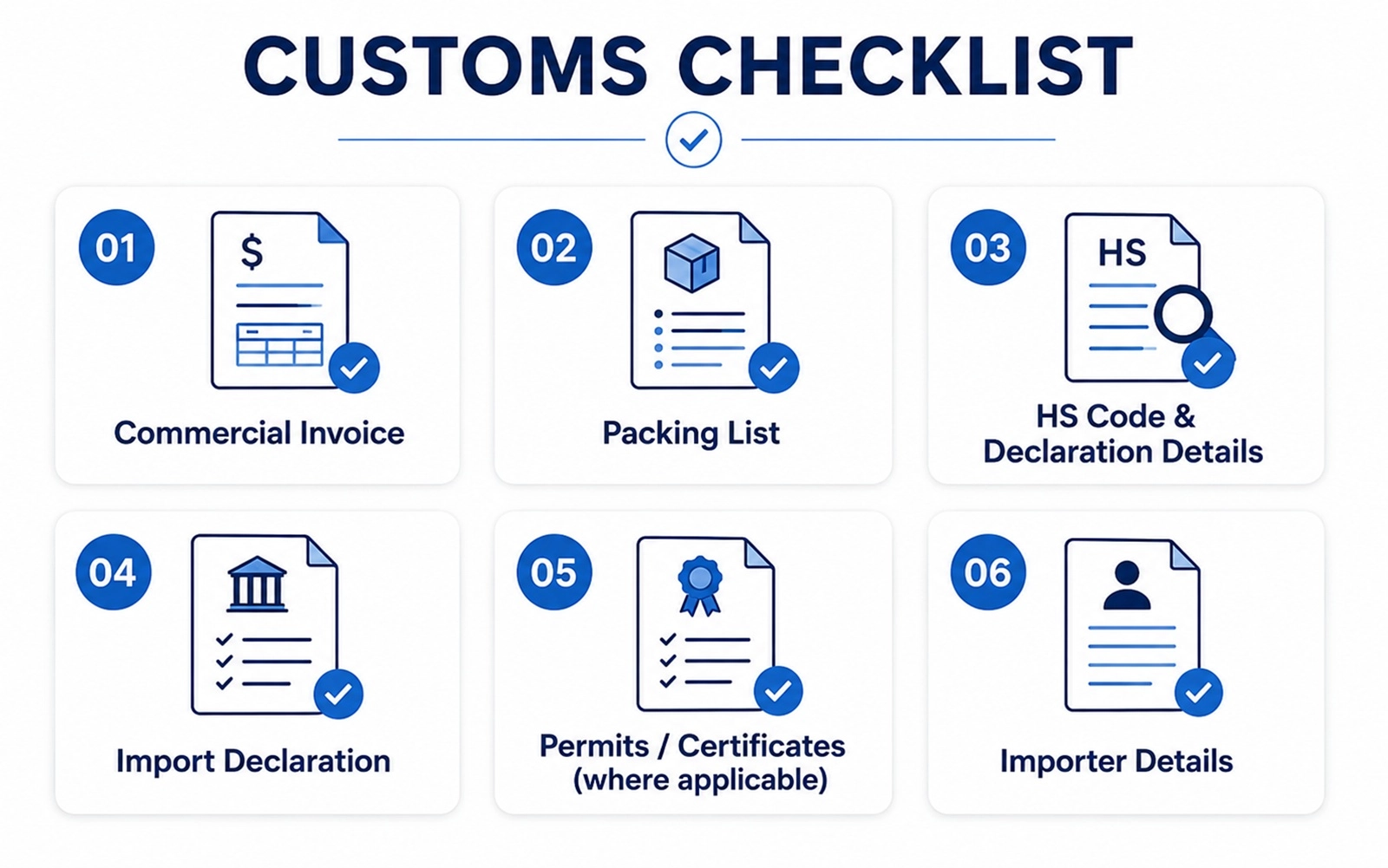
Customs preparation begins with accurate shipment information. Importers should be ready to coordinate:
- commercial and packing documents;
- clear product descriptions and quantities;
- classification and HS code information;
- importer and customs-broker responsibilities;
- any supporting documents required for the goods;
- current biosecurity conditions where relevant.
Australian Border Force provides current information about import requirements and declarations. Product classification, importer structure and declaration responsibility should be confirmed for the actual shipment. This guide does not provide legal or tax advice.
Customs or biosecurity authorities may inspect cargo. Importers should therefore keep supplier information and supporting records accessible rather than wait for a question to arise after arrival.
For more detail, read the Customs Clearance Australia guide or review Austone’s Customs Clearance service.
Amazon FBA Australia Shipping
Amazon FBA shipments connect China cargo preparation with an active Amazon shipping plan, Australian import clearance, appointment coordination and delivery to the assigned fulfilment centre. Labels, quantities and destination data should follow the current shipment rather than an older booking or warehouse reference.
Some shipments may use a direct-to-FBA pathway, while Austone commonly supports a warehouse-first workflow in which customs-cleared cargo enters its Australian warehouse before appointment and delivery. The correct route depends on the shipment and current programme requirements.
Use the complete Shipping from China to Amazon FBA Australia guide for this workflow. The two-supplier Amazon FBA case study shows how China warehouse checking and emergency relabelling were used in one real shipment without turning that outcome into a general guarantee.
Australia Warehousing and 3PL
An Australian warehouse can connect import arrival with inventory and outbound delivery. Austone’s confirmed workflow includes receiving, quantity checking, outer-carton inspection, WMS receiving, storage, inventory management, order processing, pick, check, pack or label, dispatch and delivery.
These functions can support Amazon delivery, B2B distribution and other order flows. However, local warehousing needs to fit sales stability, product margin, SKU depth and replenishment planning. It should not be added automatically to every shipment.
Read Australia 3PL Warehousing: When Does It Make Sense for China-Based Sellers? for the decision framework. The Australia 3PL service page covers commercial warehouse support.
Multi-Supplier Consolidation from China
Multi-supplier consolidation brings cargo from different factories into one controlled warehouse process before international shipment:
Supplier A + Supplier B → China Warehouse → Receiving / Checking → Consolidation → One Coordinated Shipping Plan
The operational value is coordination and traceability. Each supplier’s cargo needs to remain identifiable while quantities, cartons, labels and shipment information are checked and prepared. Consolidation should not mean losing visibility of which factory supplied each batch.
In Austone’s approved Amazon FBA case, suppliers in Foshan and Dongguan delivered into the Dongguan warehouse. The warehouse found an incorrect outer-carton SKU label on the second batch, completed emergency relabelling and maintained the planned sailing. The example shows why a China warehouse can be more than a place to hold cartons; it can be a point for detecting and responding to a supplier-side exception.
The result belongs to that shipment. It does not establish a fixed consolidation time, savings percentage or guarantee that every issue can be corrected before departure.
Planning Checklist Before Cargo Leaves China
- Confirm each supplier’s readiness date and pickup contact.
- Record accurate cargo descriptions, quantities, dimensions and weights.
- Check packaging, visible carton condition and required labels.
- Decide whether cargo should move by sea, air or an appropriate small-shipment method.
- Identify whether multiple suppliers need warehouse consolidation.
- Confirm the importer, customs broker and document responsibilities.
- Check current product-specific Australian import and biosecurity requirements.
- Decide whether cargo will move directly to delivery or through an Australian warehouse.
- Assign a contact and response process for quantity, carton, label or document discrepancies.
Frequently Asked Questions
What is the main process for shipping goods from China to Australia?
The process normally connects supplier coordination, China pickup or warehouse preparation, export handling, international freight, Australian customs clearance and final delivery. An Australian warehouse may be added when storage, checking, order processing or scheduled delivery is required.
Should I use sea freight or air freight?
Use the cargo and business requirement to decide. Sea freight commonly fits larger or regular B2B shipments, while air freight may fit urgent, higher-value or time-sensitive cargo. Compare the full route, not freight movement alone.
Can goods from several Chinese suppliers be consolidated?
Yes, when cargo can be identified, received, checked and prepared through a controlled warehouse process. Supplier-level traceability should remain clear after the goods are combined.
What documents are commonly prepared for Australian import clearance?
Commercial and packing documents are commonly part of the preparation, together with accurate product, quantity, value and classification information. The exact declaration and supporting-document requirements depend on the goods and import arrangement.
Do all shipments need an Australian warehouse?
No. A warehouse can support storage, inventory management, rework and controlled outbound delivery, but some customs-cleared shipments may be ready for direct delivery. The correct route depends on destination needs.
How should Amazon FBA shipments be planned differently?
They need to align physical cargo, labels and quantities with the active Amazon shipping plan, then coordinate clearance, any Australian warehouse handling, appointment and final FBA delivery. Use the dedicated FBA guide for the full workflow.
Plan the Next Shipping Decision
A workable China-to-Australia shipping plan begins with the cargo: what it is, when each supplier will be ready, how it should move, which import requirements apply and what needs to happen after clearance.
If you are ready to compare the route and service options, review Austone’s China to Australia Freight Services or request a shipment review. The objective is to connect the stages before cargo moves, not solve each handoff after it becomes urgent.
How Austone supports your shipping plan
We support your international cargo with a clear plan: route and mode advice, document and customs support, then arrival and delivery coordination.
- PlanRoute, mode and timing based on your cargo and deadline.
- ClearDocuments, customs and release coordinated around your shipment requirements.
- DeliverArrival, warehouse and final-mile visibility after the vessel or flight.
Get a shipping quote
Tell us the cargo, route and deadline. We will reply with a clear next step.