How Austone Fixed a Supplier Label Error Before an Amazon FBA Peak-Season Shipment
See how Austone consolidated bulky home storage products from two China suppliers, found incorrect SKU labels and completed overnight relabelling before sailing.
Case Snapshot
In September–October 2025, an Amazon Australia seller was preparing two 40HQ containers of bulky home storage products from suppliers in Foshan and Dongguan. Their delivery dates were approximately ten days apart, so Austone coordinated both batches through its Dongguan warehouse. A pre-shipment check found incorrect outer-carton SKU labels on the second batch. The warehouse arranged emergency relabelling, worked overnight and completed the correction in time to maintain the original planned sailing from Shenzhen Shekou.
The Customer Challenge
The seller needed to coordinate inventory from two factories before a peak-season sales period. One supplier was in Foshan and the other in Dongguan, and their cargo was not ready at the same time.
The shipment totalled two 40HQ containers of bulky home storage products. Because the supplier delivery dates were approximately ten days apart, the customer was concerned about missing the peak-season FBA inbound deadline. Austone needed to receive and control two separate batches, preserve the relationship between cartons and products, and prepare the consolidated cargo for departure from Shenzhen Shekou.
The destination recorded in the business material was Sydney Amazon FBA warehouse BWU1.
Why Multi-Supplier FBA Shipments Are Risky
A multi-supplier FBA shipment creates more handover points than a single-factory shipment. Cargo may become ready on different dates, and each factory may prepare cartons and labels separately. A correct result therefore depends on more than collecting both batches at one warehouse.
The warehouse must distinguish the suppliers’ cargo, check the physical cartons against the intended SKU information and prepare the shipment using the seller’s active Amazon shipping plan. A barcode that scans successfully can still refer to the wrong product. If that mismatch is not found before loading, the seller may have fewer practical options for correction later.
Amazon’s public FBA guidance requires sellers to create a shipping plan and prepare and label inventory according to the applicable requirements. Those instructions should be checked for each shipment because platform requirements and assigned destinations can change.
Austone’s Consolidation Approach
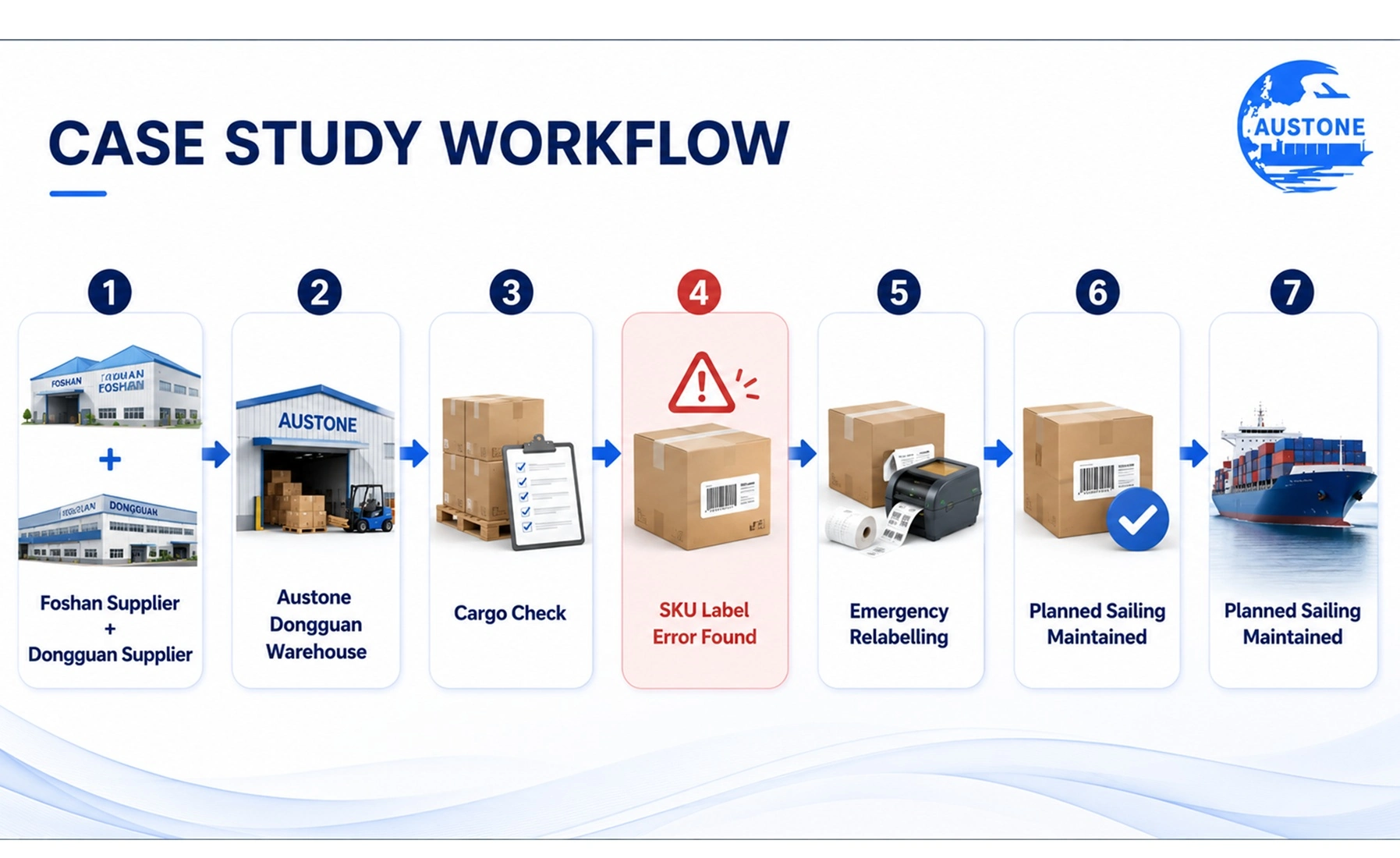
Both suppliers delivered their cargo to Austone’s Dongguan warehouse. The earlier batch could enter the warehouse process while Austone continued coordinating the later supplier, rather than leaving all preparation until both batches arrived together.
The business material records that both batches were gathered within three days and loaded together for shipment. Because the source does not define the calculation points for that three-day period, the case retains the original statement without adding a more detailed timeline.
The warehouse became the control point for:
- coordinating delivery from the Foshan and Dongguan suppliers;
- receiving and distinguishing the two cargo batches;
- checking the shipment before export;
- preparing the consolidated cargo for Shenzhen Shekou; and
- coordinating the onward China-to-Australia FBA movement.
The approach did not remove every timing risk. It gave the operations team a place to identify and handle a supplier-side exception before the cargo left China.
The Problem Found Before Departure
When Austone checked the second batch, the warehouse found that the outer cartons carried incorrect SKU labels. The labels belonged to another product batch and did not match the cargo being prepared for this shipment.
This was more than a cosmetic packaging issue. FBA preparation depends on alignment between the physical goods, carton labels and the seller’s shipment information. Allowing the affected cartons to continue unchanged could have carried the mismatch into later transport and receiving stages.
The finding demonstrated the value of checking what a supplier had applied rather than assuming that an existing label was correct.
How Austone Responded
Austone stopped the affected preparation work and arranged emergency relabelling in the Dongguan warehouse. The team replaced the incorrect outer-carton SKU labels and worked overnight to complete the correction.
After the affected cartons had been relabelled, Austone completed the consolidation and shipment preparation. The two 40HQ containers then maintained the original planned sailing from Shenzhen Shekou.
This records what happened in one shipment. It does not mean every labelling problem can be corrected overnight or every sailing can be protected. The response depends on when the problem is found, the affected volume, access to correct label data and the remaining operational window.
The Result
The immediate result was clear: the SKU label error was identified before departure, the affected cartons were relabelled at the China warehouse, and the shipment maintained its original planned sailing.
The shipment arrived at Sydney Amazon FBA warehouse BWU1 on schedule. The inventory was successfully made available for sale and caught the Prime Day promotion. The source records that the customer’s products sold out during the promotion period.
These outcomes must remain correctly attributed. Austone’s operational work corrected the label problem and maintained the planned sailing. The later sales result is recorded as part of the case outcome, but the article does not claim that Austone caused the sell-out or can guarantee similar commercial results.
What Amazon Sellers Can Learn
Use one control point for separated supplier deliveries
When factories are ready on different dates, a consolidation warehouse can provide a controlled point for receiving, identification and preparation before export.
Check labels against the actual SKU and shipment data
The presence of a label is not proof that it is correct. Here, the second batch’s outer-carton labels referred to another product batch.
Preserve time for exception handling before loading
Finding the error in Dongguan allowed Austone to organise replacement labels while the cargo was still in China. A later discovery could have reduced the available options.
Coordinate the factories, warehouse and freight plan together
Supplier readiness, warehouse work and the planned sailing were connected. Managing them separately would have made the ten-day gap and label exception harder to control.
This case shows one example of China-side coordination before an Amazon FBA shipment. For the broader route from supplier preparation through customs and delivery, see the shipping process overview.
Frequently Asked Questions
Can two Chinese suppliers be consolidated for Amazon FBA Australia?
Yes. Cargo can be brought to a consolidation warehouse, provided the operation maintains supplier and SKU traceability and prepares cartons against the seller’s current Amazon shipping plan.
Why check SKU labels if a supplier has already applied them?
Because a label may scan correctly but refer to the wrong SKU or product batch. That is what Austone found on the second batch in this case.
Can an FBA label error be corrected before export?
It may be possible when the error is found early enough and the warehouse has the correct label information, suitable labour and enough time. In this case, Austone completed emergency relabelling overnight.
Does warehouse consolidation guarantee the Amazon delivery deadline?
No. It can improve coordination and make some exceptions easier to handle, but vessel schedules, customs processes, delivery appointments and Amazon receiving remain separate variables.
What should sellers provide before suppliers dispatch?
Sellers should provide current shipment-plan information and the correct carton and SKU label data. The precise preparation instructions should be checked in the active Amazon workflow.
Planning a Multi-Supplier Amazon FBA Shipment?
If your Amazon inventory comes from more than one factory in China, Austone can review the supplier delivery sequence, consolidation requirements, pre-shipment checks and China-to-Australia FBA coordination before cargo moves. Learn more about Austone’s Amazon FBA logistics services from China, or discuss your shipment with Austone.
Need support with your next shipment?
Speak with our logistics specialists about your international freight and supply chain requirements.
Experience shows in the details before cargo moves
Industry Knowledge
Understanding cargo characteristics, supplier conditions and destination requirements shapes the right plan.
Operational Experience
Coordinating factories, documentation, carriers and arrival handling keeps complex shipments on schedule.
Professional Judgment
When conditions change, clear communication and practical adjustments protect the delivery outcome.