Australia 3PL Warehousing: When Does It Make Sense for China-Based Sellers?
Decide whether an Australian 3PL fits your sales, margins, SKU depth and inventory plan using Austone’s real warehouse workflow and exception handling.
Guide Overview
- Main Topics
- Process, Costs, Delivery
An Australian 3PL makes sense when local inventory turns reliably and the value of faster, controlled fulfilment exceeds storage, handling and last-mile costs. It can support Amazon delivery, B2B store replenishment and direct-to-consumer dispatch, but it is not automatically the right choice for every seller. China-based businesses should evaluate sales stability, product margin, SKU depth and replenishment discipline before placing stock overseas. This guide uses Austone’s actual warehouse process to show both the operational value and the situations where a 3PL may not be justified.
Key Takeaways
- A 3PL is a stock-flow decision, not simply storage.
- Receiving should reconcile cargo, quantity, carton condition and labels before put-away.
- WMS visibility does not replace replenishment planning.
- Relabelling, returns and exception handling can justify local capability.
- Unstable sales, weak margins and fragmented SKUs are warning signs.
What Happens After Cargo Arrives?
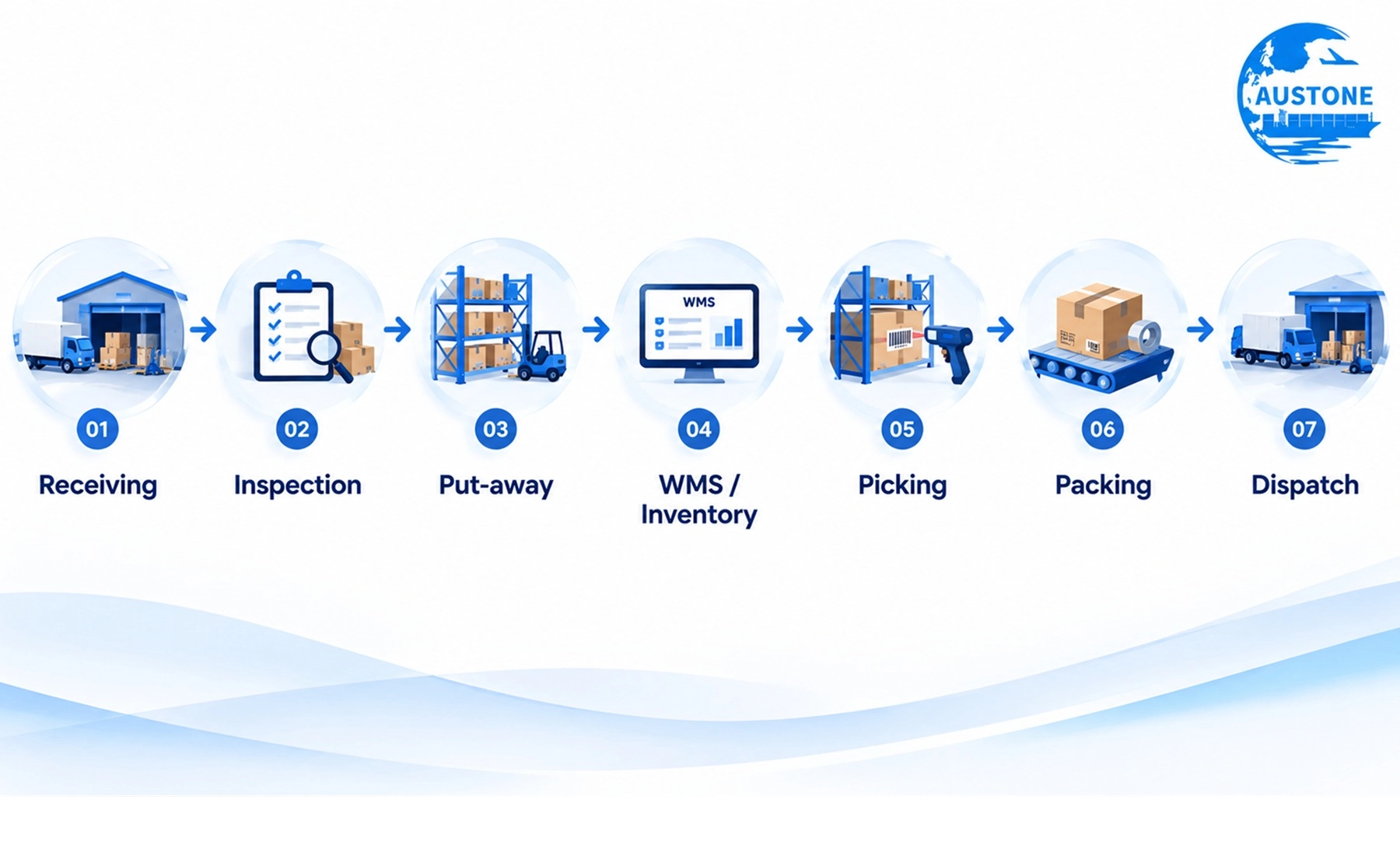
Austone’s confirmed workflow is: receiving → quantity check → outer-carton inspection → WMS receiving → storage → inventory management → order processing → pick → check → pack/label → dispatch → delivery.
This connects import arrival with sellable inventory and outbound orders. The value comes from controlled handoffs and traceability, not storage alone.
Australia warehousing is one stage within the broader shipping journey. See the complete shipping process from China to Australia for the route from supplier coordination to final delivery.
What Does Austone Check During Receiving?
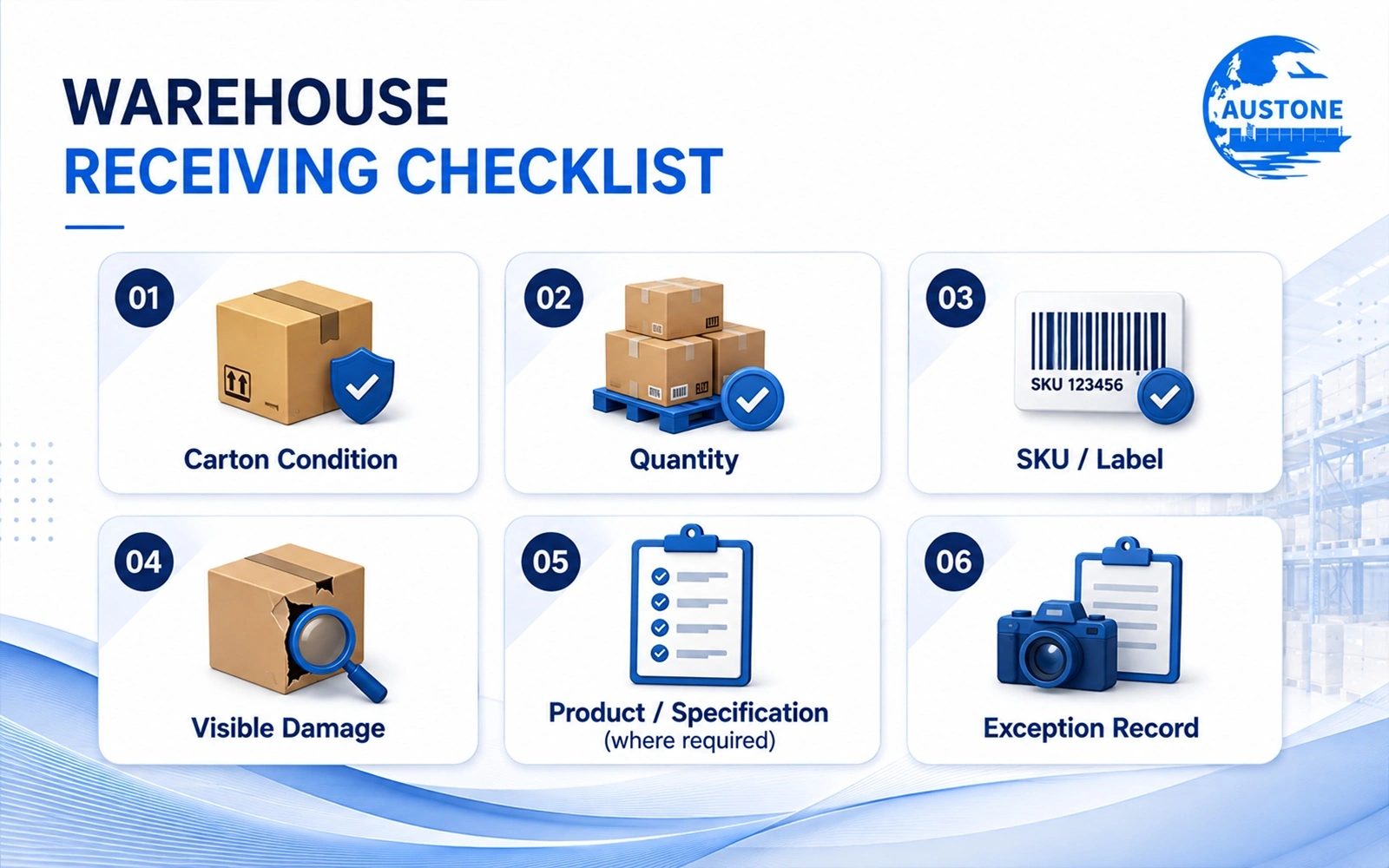
The warehouse compares the inbound record with physical cargo, checks cartons for damage, moisture or deformation, counts quantities and reviews visible carton marks/SKU labels. The scope of any deeper quality inspection should be agreed separately.
How Are Receiving Exceptions Handled?
Quantity Mismatch
Austone records the actual received quantity, takes photographs, notifies the customer and provides the evidence.
Damaged Outer Carton
The warehouse opens the carton and checks the goods. If intact, the goods are reboxed and received. If damaged, they are isolated and photographed, then handled according to the customer’s instruction.
Wrong or Missing Label
Receiving is paused. Austone confirms the correct label with the customer, performs agreed relabelling and then completes receipt into stock.
Which Operations Are Confirmed?
| Need | Austone Capability |
|---|---|
| Inbound | Full-container unloading and loose-cargo receiving |
| Pallets/cartons | Full-pallet dispatch and carton opening |
| Fulfilment | Pick, check, pack, label and dispatch |
| Labels | Labelling and relabelling |
| Channels | Amazon delivery, B2B store delivery and single-order fulfilment |
| Inventory | WMS receiving, storage, inventory management and inventory counts |
| Exceptions | Returns handling and agreed quality inspection |
Geographic coverage, cargo acceptance, integrations, prices and service levels must be confirmed for each customer because the source does not specify them.
When Does an Australia 3PL Make Sense?
A stronger fit exists when sales are stable enough to support local stock, product margin can carry receiving/storage/fulfilment costs, sales channels need Australian dispatch, local rework has genuine value and the seller maintains a replenishment rhythm.
The seller should model the full cost per order, including receiving, storage, pick and pack, packaging, labelling, returns and last-mile delivery.
When Australia 3PL May NOT Be the Right Choice
1. Sales Are Unstable and Inventory Turns Slowly
Storage costs can accumulate while stock remains idle. Smaller replenishments or direct-from-China fulfilment may deserve comparison.
2. Product Margin Is Too Low
Very low selling-price products may not cover warehouse handling and last-mile delivery. Model contribution after fulfilment, not storage alone.
3. There Are Many SKUs but Little Stock per SKU
Extreme SKU fragmentation can increase receiving, location and picking complexity without enough throughput per SKU.
4. The Seller Has No Inventory-Turn Plan
Without forecasting and reorder points, overseas stock may alternate between excess inventory and stockouts. A WMS reports inventory but cannot repair purchasing decisions.
The purpose of this check is not to reject smaller sellers. A 3PL works best when inventory movement, margin and replenishment planning support the warehouse model.
A Practical Fit Check
| Question | Stronger Fit | Warning Signal |
|---|---|---|
| Are sales predictable? | Repeatable demand | Irregular sales and idle stock |
| Can margin support fulfilment? | Viable after handling and delivery | Costs consume contribution margin |
| Is SKU depth workable? | Meaningful movement per SKU | Many SKUs with shallow stock |
| Is replenishment planned? | Reorder points maintained | Excess stock or frequent stockouts |
| Is local handling valuable? | Amazon, B2B, DTC, returns or relabelling needs | Little activity beyond storage |
Austone Operational Perspective
Austone’s warehouse process uses control points: receive against the inbound record, record actual quantities, inspect carton condition, pause unidentified stock, maintain WMS locations and verify picked orders.
For China-based sellers, the strategic question is whether those controls solve a real business problem at a sustainable cost. If stock does not turn, margins are too thin or replenishment is unmanaged, delaying 3PL adoption may be the more responsible decision.
Frequently Asked Questions
How do I know whether an Australian 3PL is worth the cost?
Compare total cost per unit or order with margin, sales velocity and the commercial value of local inventory availability.
Can an Australian 3PL deliver to Amazon FBA?
Yes, Austone’s confirmed capabilities include Amazon fulfilment-centre delivery. The active shipping plan, labels and appointment requirements still apply. See the FBA shipping guide.
What happens if cartons arrive damaged?
The goods are inspected. Intact goods can be reboxed; damaged goods are isolated, photographed and handled under the customer’s instruction.
Is a 3PL suitable for hundreds of low-volume SKUs?
It may not be. High SKU count with shallow inventory can create disproportionate warehouse complexity.
Does WMS prevent stockouts?
No. WMS improves visibility, but the seller still needs forecasting, reorder points and replenishment planning.
Decide With Your Inventory Data
An Australian 3PL is useful when it supports reliable stock flow and a workable fulfilment model. Austone can review the inbound profile, SKU structure, sales channels and required warehouse operations before inventory moves. See Austone’s Australia 3PL and warehousing service or request a 3PL fit review.
How Austone supports your shipping plan
We support your international cargo with a clear plan: route and mode advice, document and customs support, then arrival and delivery coordination.
- PlanRoute, mode and timing based on your cargo and deadline.
- ClearDocuments, customs and release coordinated around your shipment requirements.
- DeliverArrival, warehouse and final-mile visibility after the vessel or flight.
Get a shipping quote
Tell us the cargo, route and deadline. We will reply with a clear next step.