Rolled Cargo vs Vessel Delay vs Port Congestion: What Importers Need to Know
Learn how rolled cargo, vessel delay and port congestion differ, how to identify each disruption, what costs may arise and what importers can do next.
Guide Overview
- Shipping Modes
- Air Freight
- Main Topics
- Process, Documents, Timeline, Costs
Rolled cargo means a container did not load onto its scheduled vessel. A vessel delay means the voyage itself moved later. Port congestion means a port cannot process arriving vessels or containers fast enough. These disruptions can overlap, but their causes, cost exposure and response options are different.
For Australian importers shipping FCL or LCL cargo from China, identifying the correct disruption is the first step toward protecting delivery dates, communicating with buyers and deciding whether any practical recovery option exists.
Key Takeaways
- Rolled cargo: the container remains behind while the planned vessel sails.
- Vessel delay: all cargo on the voyage moves later with the vessel.
- Port congestion: vessel or container flow slows across a terminal or port.
- Cost exposure depends on the cause and stage: time lost at anchorage is different from storage or detention after discharge.
- A vessel-name change is not automatically a roll: it may be a service-level reallocation.
Rolled Cargo, Vessel Delay and Port Congestion Compared
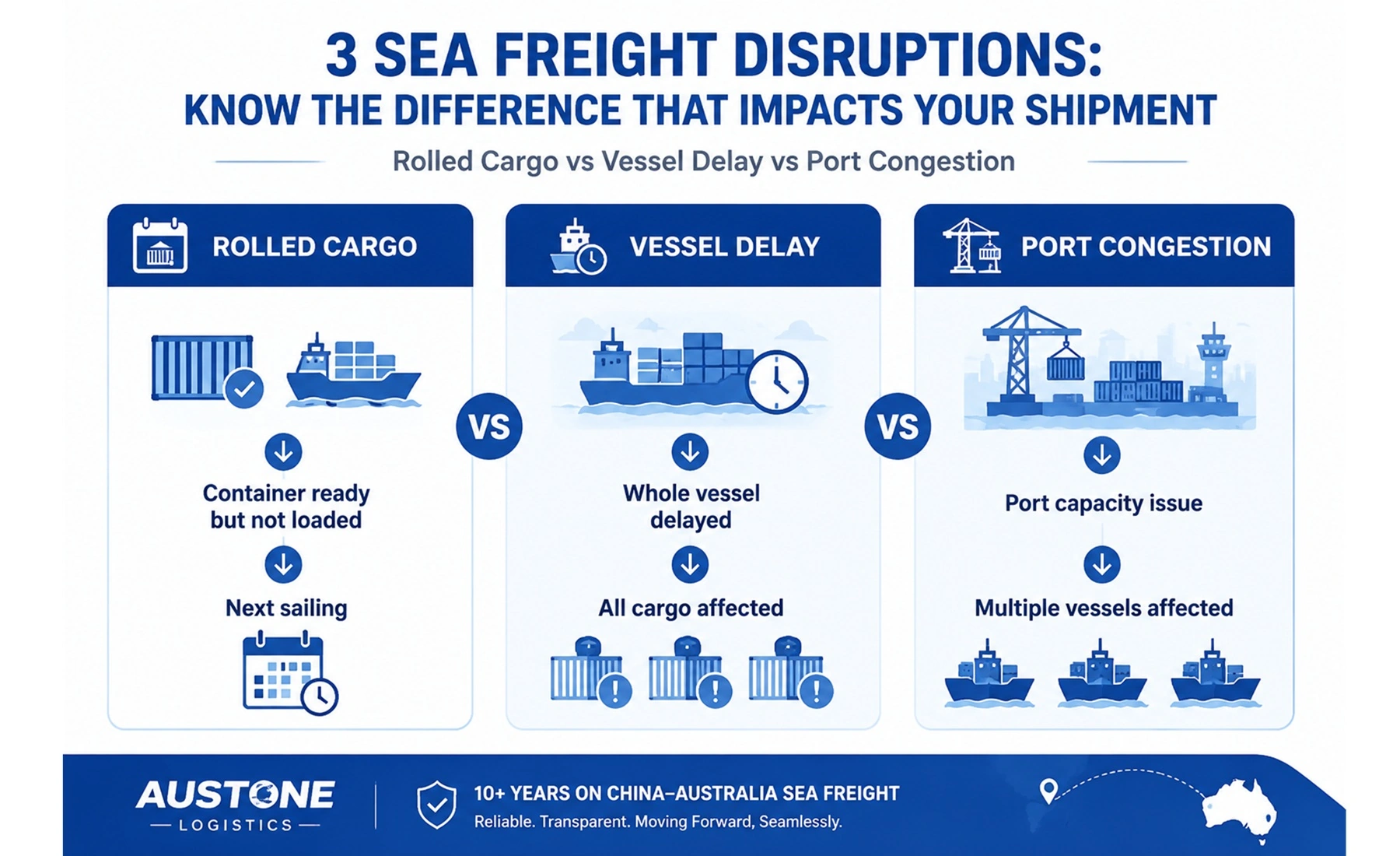
| Factor | Rolled Cargo | Vessel Delay | Port Congestion |
|---|---|---|---|
| Cargo status | At the terminal but not loaded on the scheduled vessel | Usually loaded; the whole voyage is late | May be on board, at anchorage or waiting in a congested yard |
| Who is affected | One booking or a group of containers | All cargo on that vessel or voyage | Multiple vessels, services or terminal users |
| Typical tracking clue | Gate-in or customs released, with no departure event | Departure or ETA is revised for the voyage | Long gaps and widespread berth, discharge or yard delays |
| Practical response | Confirm cause and next sailing; consider another carrier or air freight for urgent cargo | Update delivery plans and prepare destination handling for the revised ETA | Identify the bottleneck, monitor official updates and prepare pickup as soon as cargo is available |
| Possible extra cost | Amendment, storage or container charges depending on cause and terms | Usually indirect delay costs rather than extra terminal charges | No storage or detention while cargo remains on board; charges may arise after discharge depending on free time |
What Is Rolled Cargo?
Rolled cargo is cargo accepted for a sailing but not loaded onto the scheduled vessel. The container remains at the origin terminal and is normally moved to a later sailing. A carrier capacity decision can cause a roll, but late gate-in, missed cut-offs, customs inspection, weight or draft restrictions and other operational constraints can produce a similar outcome.
How to Recognise Rolled Cargo
Tracking may stop at “gate-in” or “customs released” without a vessel departure record. Other cargo on the same vessel may sail normally. Ask the freight forwarder to confirm whether the event was carrier-caused, shipper-side or related to terminal operations, because that distinction affects both recovery options and potential charges.
Why Containers Get Rolled
- Capacity and accepted bookings: usable vessel space can be lower than accepted demand for a sailing.
- Late operations: a missed terminal cut-off, late gate-in or delayed customs release can prevent loading.
- Vessel constraints: draft, weight, stability, weather or last-minute operational limits can reduce the planned load.
- Allocation decisions: loading priority depends on carrier policy, contract terms and operational circumstances. There is no universal rule that one cargo type is always rolled first.
As an illustration only—not real carrier data—if usable space were 5,000 containers while accepted bookings reached 7,000, some bookings could not load. Actual allocation and overbooking practices vary by carrier, route and season.
What Is a Vessel Delay?
A vessel delay occurs when the vessel cannot depart, sail or arrive according to the original schedule. Every shipment on that voyage moves later together. Common causes include severe weather, vessel repairs, an earlier port delay, skipped port calls, blank sailings or carrier schedule adjustments.
The key signal is a revised departure time or ETA for the whole voyage. Because the cargo is normally already assigned or loaded, the main action is to obtain the official delay notice, update the buyer and prepare customs clearance and trucking around the new arrival date.
What Is Port Congestion?
Port congestion occurs when berth space, yard capacity, labour, equipment or landside transport cannot process the arriving volume quickly enough. Vessels may wait at anchorage, discharged containers may remain in the yard, and delays can spread across multiple services.
Where the Bottleneck Matters
If a container is still on board waiting for a berth, storage and detention are not accruing simply because the vessel is at anchorage. After discharge, terminal storage or container-related charges may arise if the container cannot be collected within the applicable free-time rules. The responsible party and any waiver depend on the facts and the carrier, terminal and contract terms.
Common Causes of Port Congestion
- Seasonal or unexpected cargo surges
- Berth, crane, labour or trucking constraints
- Yard saturation and slow empty-container evacuation
- Vessel bunching after wider route disruptions
- Inspection or clearance backlogs that slow container removal
Austone Operational Experience
In Austone’s operations, capacity-driven container rolls are relatively uncommon because protected or contracted carrier allocation is normally confirmed before container pickup. Vessel-level reallocation or a vessel-name change is encountered more often. The planned vessel may be adjusted or replaced while the booking remains intact, so a vessel-name change alone does not prove that an individual container was rolled.
Capacity pressure deserves additional attention before China’s National Day holiday, Christmas and Chinese New Year. This is an observation from Austone shipment flows rather than a universal rule; conditions vary by route, carrier and season.
When a carrier-capacity roll occurs, Austone confirms the cause, pushes for loading priority where operationally possible and arranges the next available sailing if the original plan cannot be restored. On a weekly service, the additional delay may be approximately five to seven days, but the actual result depends on service frequency and the next vessel call.
How to Respond to Each Disruption
If Your Cargo Is Rolled
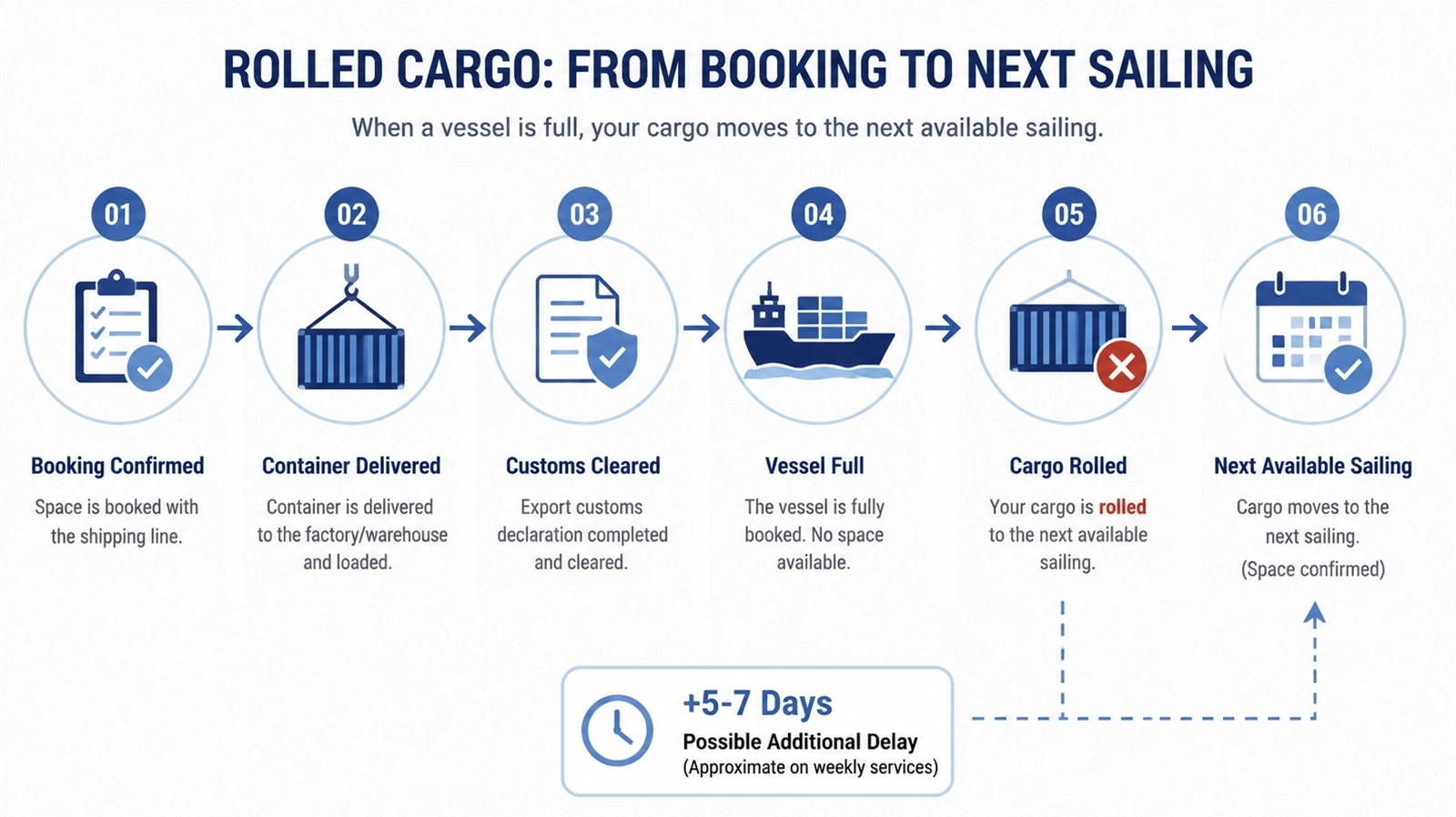
- Ask the forwarder to confirm the exact cause and the next confirmed sailing.
- Check whether documentation or customs formalities need amendment.
- For urgent cargo, compare another carrier, a nearby origin option or air freight for the critical portion.
- Request a written cost breakdown and seek appropriate waivers where the carrier caused the roll.
- Notify the buyer early with a realistic revised timeline.
If the Vessel Is Delayed
- Obtain the carrier or forwarder’s official schedule-change notice.
- Compare the revised ETA with contractual delivery and stock requirements.
- Update the buyer before the revised date becomes a dispute.
- Alert the destination customs broker and trucking team so resources are ready for arrival.
If the Port Is Congested
- Identify whether the bottleneck is at origin, transshipment or destination.
- Confirm whether cargo is on board, awaiting discharge or already in the terminal yard.
- Monitor carrier and terminal notices instead of relying only on an unchanged ETA.
- Prepare documents and pickup arrangements so avoidable delay is not added after release.
- For future cycles, spread volume or review alternate routings before peak periods.
How a Freight Forwarder Can Reduce the Impact
Before departure, a freight forwarder should confirm space, track cut-offs, check Verified Gross Mass and documentation, and flag route or terminal risks. These controls fit within the wider international freight forwarding process.
After a disruption, the forwarder should explain what happened, provide a revised sailing or ETA, identify documentation and cost consequences, coordinate destination resources and present realistic alternatives. For planning context, see how long shipping from China to Australia takes.
Frequently Asked Questions
My tracking has not updated for a week. Which disruption is it?
A gate-in or customs-release status with no departure may indicate rolled cargo. A recorded departure followed by a changing ETA points to vessel delay. Widespread delays around berth, discharge or terminal availability may indicate port congestion. Ask the forwarder to confirm against the carrier and terminal record.
Can I pay extra to speed up a delayed shipment?
Sometimes, but mainly when cargo has not sailed. A rolled container may be moved to another carrier, and a critical portion may be sent by air. A vessel already underway cannot be individually accelerated, and port-wide congestion usually offers limited shipment-specific options.
Who pays storage and detention after a disruption?
Liability depends on the cause, the point in the journey, free-time rules and applicable terms. Carrier-caused costs may be disputed or considered for waiver. Shipper-side missed cut-offs or post-discharge pickup delays may create importer costs. Confirm the facts before accepting any charge.
Does origin congestion differ from destination congestion?
Yes. Origin congestion can prevent a container from loading and may contribute to rolling. Destination congestion normally affects berth availability, discharge and pickup after the cargo has sailed.
Does a vessel-name change mean my container was rolled?
No. A carrier may reallocate a service or booking to a different vessel. Rolling is a container-level event in which cargo does not load onto its scheduled sailing.
How much delay can a carrier roll add?
On a weekly service, the next available sailing may add approximately five to seven days. The actual delay depends on the route, service frequency, space confirmation and the next vessel call.
How Austone Can Help
Austone helps importers distinguish container-level rolling from vessel and port disruption, confirm the cause, obtain revised schedules, coordinate documentation and destination handling, and request carrier consideration where appropriate.
Dealing with a delayed shipment or planning for the next peak season? Request a freight review from Austone for a route-specific assessment and practical next steps.
How Austone supports your shipping plan
We support your international cargo with a clear plan: route and mode advice, document and customs support, then arrival and delivery coordination.
- PlanRoute, mode and timing based on your cargo and deadline.
- ClearDocuments, customs and release coordinated around your shipment requirements.
- DeliverArrival, warehouse and final-mile visibility after the vessel or flight.
Get a shipping quote
Tell us the cargo, route and deadline. We will reply with a clear next step.