Canton Fair 2026 Guide for Australian Buyers
Planning to attend the Canton Fair from Australia? This guide covers the 2026 autumn phases, supplier checks, multi-supplier sourcing and practical China-to-Australia shipping preparation.
Guide Overview
- Shipping Modes
- Sea Freight / Air Freight
- Main Topics
- Process, Documents, Costs, Customs
If you’re travelling from Australia to source products at the 140th Canton Fair, choosing the right phase is only the beginning. You also need a way to compare suppliers, confirm product requirements and organise the orders for delivery to Australia.
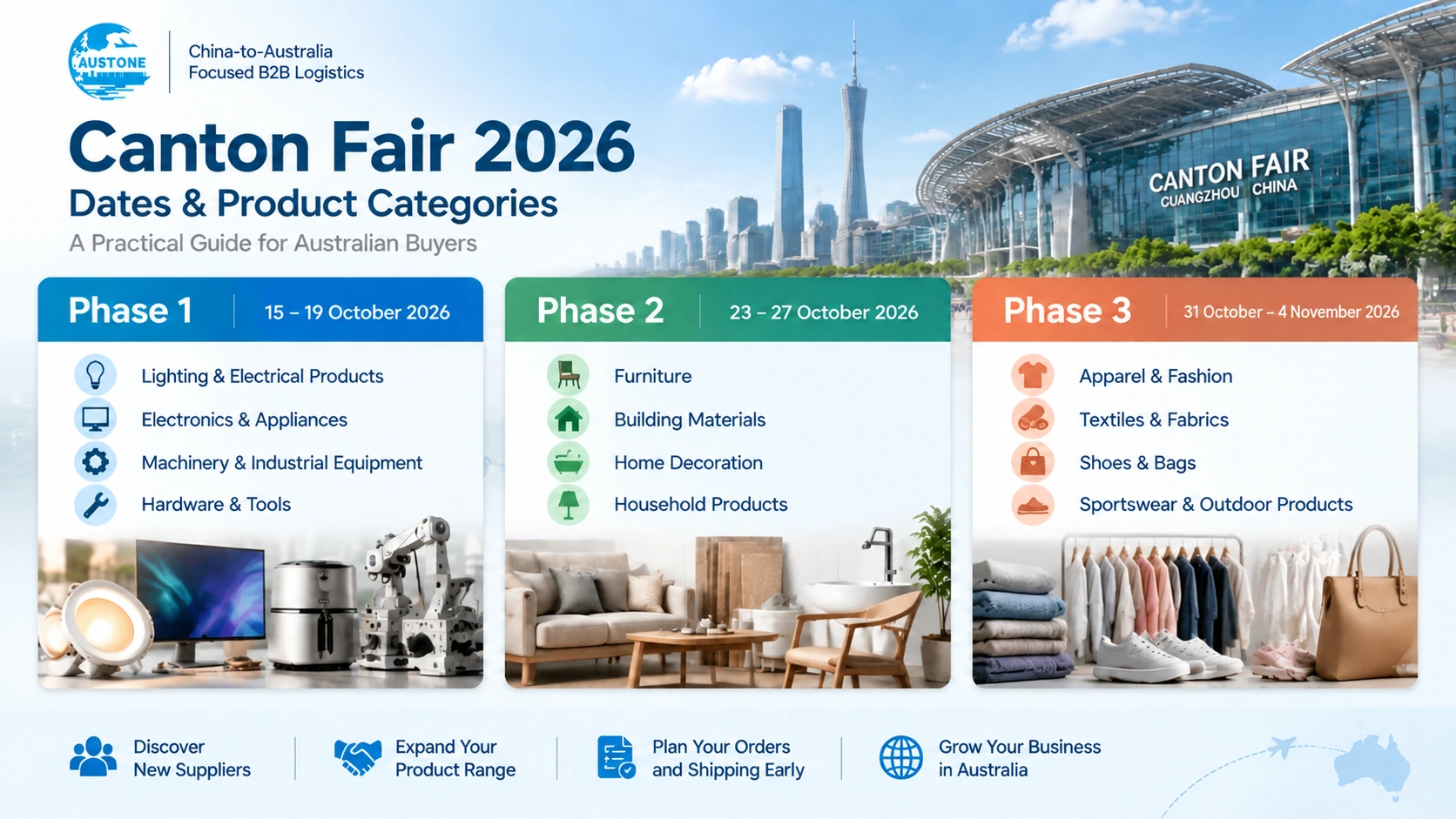
The autumn Canton Fair 2026 runs in three phases: 15–19 October, 23–27 October and 31 October–4 November, in Guangzhou. Start with Phase 1 for lighting and electrical products, Phase 2 for furniture and building materials, or Phase 3 for apparel and textiles. The official session details confirm the dates and categories.
This guide helps Australian importers, retailers, distributors, procurement teams and e-commerce businesses prepare a sourcing brief, ask useful questions at each booth and collect the cargo information needed afterwards. It also explains how supplier locations, production dates, packaging and Australian import requirements affect consolidation, freight costs and final delivery. Use it before the trip and keep the supplier checklist handy while you walk the fair.
Canton Fair 2026 Dates at a Glance
This guide covers the 140th Canton Fair in autumn 2026. The spring session is a separate event.
| Phase | Dates | Main categories relevant to this guide | Best suited for |
|---|---|---|---|
| Phase 1 | 15–19 October 2026 | Lighting, electrical and electronic products, appliances, machinery, hardware and tools | Lighting distributors, electrical-product importers, equipment buyers and technical procurement teams |
| Phase 2 | 23–27 October 2026 | Furniture, building and decorative materials, sanitary and bathroom equipment, household goods | Furniture retailers, building-product distributors, fit-out and project buyers |
| Phase 3 | 31 October–4 November 2026 | Clothing, sportswear, textiles, fabrics, shoes and bags | Apparel brands, uniform suppliers, textile importers and inventory-based retailers |
Venue: China Import and Export Fair Complex, 382 Yuejiang Zhong Road, Haizhu District, Guangzhou, China. Business hours: 09:30–18:00, Guangzhou local time (UTC+8).
The table summarises selected categories, rather than the full exhibition directory. Dates, hours and venue are confirmed in the organiser’s current fair overview. The 140th session announcement hosted by MOFCOM also lists the phases and sectors.
There are changeover intervals on 20–22 and 28–30 October. Do not plan those days as normal exhibition days. These are the overall fair dates; the Import Exhibition or International Pavilion is a specific programme within the fair, not the name for your purchases entering Australia.
Quick Answer for Australian Buyers
- Lighting or electrical products? Phase 1: 15–19 October 2026.
- Furniture or building materials? Phase 2: 23–27 October 2026.
- Apparel or textiles? Phase 3: 31 October–4 November 2026.
- Buying from several suppliers? Collect pickup location, packed size, weight and cargo-ready date while you’re at the fair.
Which Canton Fair Phase Should Australian Buyers Attend?
Choose your phase around the products you intend to buy and the people who need to assess them. A broad project brief may span more than one phase: a commercial fit-out could involve lighting in Phase 1 and furniture or bathroom equipment in Phase 2.
Before committing to a travel itinerary, match your priority products against the official exhibitor and product platform. Check the current listing and booth details for shortlisted suppliers. A supplier’s wider catalogue does not mean every product will be displayed at its booth.
Prioritise suppliers who fit your buying brief. For technical or project purchases, decide who can approve specifications and what still needs checking before an order.
Phase 1: Lighting and Electrical Buyers
For Australian lighting buyers, record the exact model, electrical specifications, driver or power-supply configuration and materials where relevant. Photograph the product label and connect it to the quotation. Ask which test reports and compliance documents are available for that exact configuration.
Australian electrical requirements should be considered before ordering. Check applicable RCM requirements through the EESS compliance steps and ACMA supplier guidance. A supplier’s “Australia compliant” claim still needs supporting evidence. For the detail, read RCM vs SAA for lighting imports into Australia.
For fragile fittings, ask how glass, shades and finished surfaces are protected. For long track lights, collect the packed length and outer dimensions. Confirm whether tracks, drivers and fittings travel together or from different suppliers, and whether cartons can be stacked.
Record the factory city and pickup address even when the sales meeting takes place in Guangzhou. Those details affect pickup, handling and consolidation.
Phase 2: Furniture and Building Materials Buyers
Furniture, stone, tiles and bathroom products can create very different handling demands. Take four questions to the booth:
- Packed dimensions / CBM: What is the volume in cubic metres, including crates, pallets and protective frames? Does furniture ship assembled or flat-packed?
- Weight / handling: What is the gross weight per package? Can it be stacked and lifted by forklift? Heavy or oversized pieces affect container utilisation and compatibility with other suppliers’ cargo.
- Timber / wood packaging: Identify timber in the product separately from wood or bamboo used for packing. Australia’s timber and bamboo packaging guidance explains why conditions differ by material and use.
- Final delivery: Is the destination a warehouse, showroom or construction site? Confirm access, unloading equipment and who receives the cargo. Residential delivery within a business-managed project needs a separately scoped access and handling plan.
If your sourcing trip includes Guangzhou or Foshan, record the actual factory pickup address. Do not assume furniture exhibitors all manufacture in Foshan or keep stock near the fair.
Phase 3: Apparel and Textile Buyers
Apparel sourcing needs a consistent product record across sizes, colours and factories. Agree model or SKU references, fabric composition, size breakdowns, labelling artwork, quantities and the required packing-list format before production.
Ask how mixed cartons will be identified. If one carton contains several sizes or colours, the packing list should make the contents traceable. Keep the approved sample reference with the specification so that later discussions concern the same product.
For sportswear and uniforms, record the actual required delivery date, including the event or retail intake deadline. A factory’s production completion date is only one milestone. Packing, document checks, collection, freight and Australian receiving still need time in the plan.
When ordering from several factories, use one data template and nominate a contact at each supplier. Update cargo-ready dates as production changes. For repeat replenishment, retain the confirmed SKU, carton and packing information, while checking whether a new order changes quantities, composition or packaging. This makes the next shipment easier to plan without assuming it is identical to the first.
What to Prepare Before Visiting Canton Fair
Bring a short sourcing brief that makes quotations comparable: product categories, specifications, target MOQ, quantities, budget and commercial requirements. Distinguish your trial order from possible repeat purchases.
Shortlist suppliers and ask about sample terms, production timing, quality checks and which company will contract and invoice. Supplier verification and product acceptance still need their own process.
Add a preliminary shipping brief: Australian destination city and postcode, approximate volume, required arrival window and delivery setting. Flag heavy, fragile or unusually long goods.
When comparing prices, ask for the currency, trade term and named place, plus what packaging and origin handling are included. Keep unanswered questions beside each quotation.
Official Canton Fair Resources for Overseas Buyers
- Pre-registration and buyer badges: Start with the official Canton Fair platform for current information and application routes.
- Exhibitor and product search: Use the same official platform to check shortlisted suppliers.
- Attendance preparation: Consult the 2026 Overseas Buyer Attendance Guide and check for later official notices.
Check current procedures before departure and China entry requirements for your passport and itinerary separately. An invitation does not establish travel eligibility.
Save This Supplier Checklist Before You Visit Canton Fair
Open this checklist when you’re speaking with suppliers. Keep one record per supplier, attach photos and quotations, and mark estimates for confirmation before booking. Collect supporting documents where relevant to your cargo.
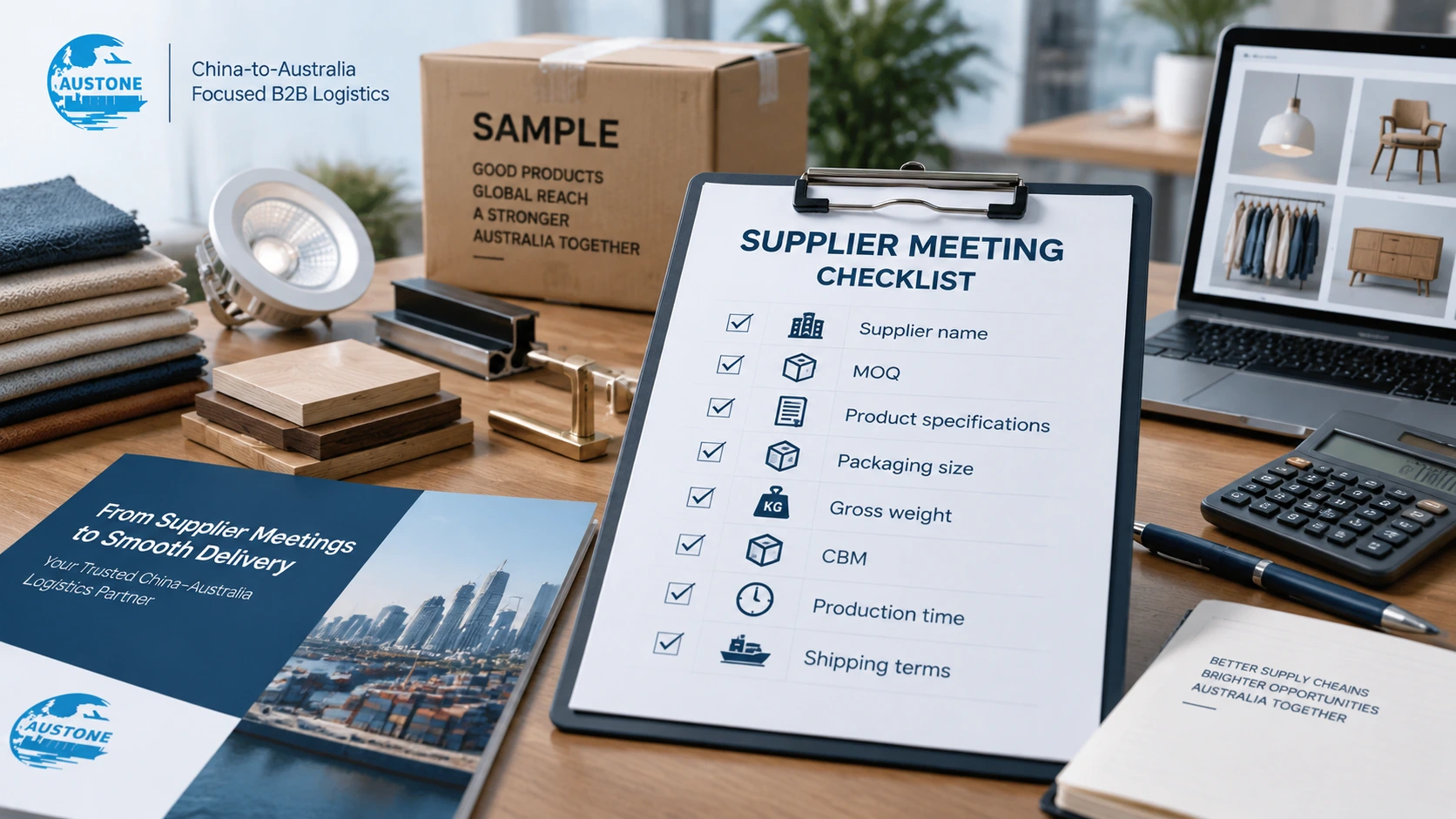
| Ask the supplier | Record on your phone |
|---|---|
| Which company will supply and invoice the goods? | Company name, contact person, email or messaging contact |
| Where will the order be collected? | Factory or pickup address, city, collection contact |
| Which exact products are quoted? | Description, model/SKU, sample reference, materials or composition |
| What are the order terms? | MOQ, quantity by SKU, currency, trade term and named place |
| How will the goods be packed? | Number of cartons, crates or pallets; units per package; mixed-carton details |
| What are the packed measurements? | Length × width × height with units, by package type |
| How much does each package weigh? | Gross weight and total shipment gross weight |
| What is the estimated packed volume? | CBM, including the proposed outer packing |
| Is wood or bamboo used? | Product materials and packaging materials recorded separately |
| Can you send packing photos? | Product protection, outer packing and marks where relevant |
| When will the order be ready for collection? | Cargo-ready date, outstanding steps and update contact |
| What documents can you provide? | Commercial invoice, packing list, specifications and available compliance documents where relevant |
| Are there handling restrictions? | Fragility, non-stackable packages, lifting needs or other special features |
Add your Australian destination, postcode, receiving contact and unloading or booking requirements to the same record.
If carton sizes, weight or ready dates are missing, record who will confirm them and when.
Buying From Multiple Suppliers at Canton Fair?
Build the logistics plan while orders are being agreed. Do not wait until every supplier is ready. Suppliers A, B, C and D may be in different cities, finish on different dates and have different packaging and shipment sizes. Treating their orders as one purchase does not automatically make them one workable shipment.
The planning sequence is supplier list → pickup planning → cargo receiving → consolidation → shipment planning → shipping to Australia.
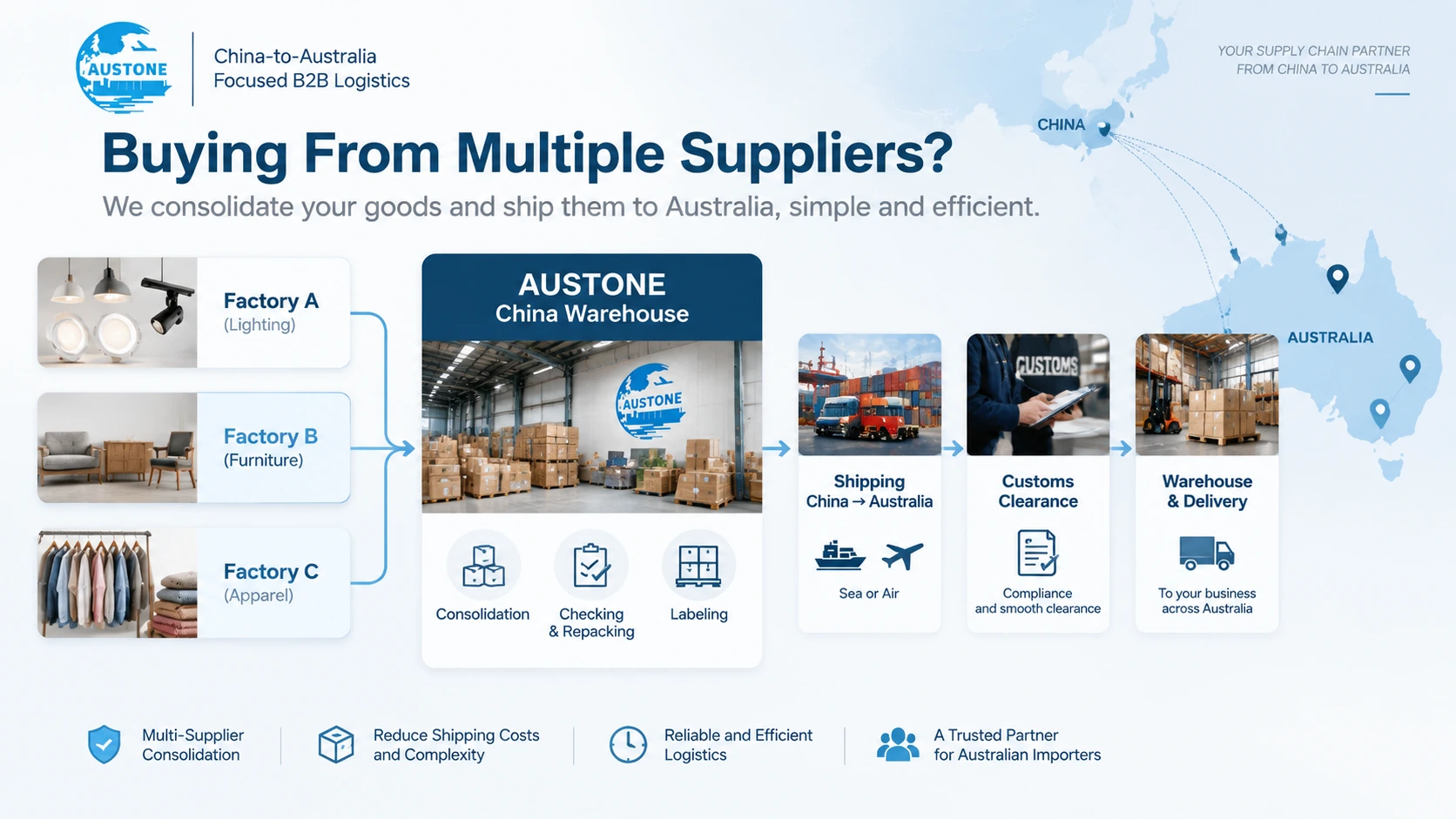
Consolidation means bringing compatible orders together for a coordinated onward shipment. It can simplify the receiving plan, but it is not automatically cheaper or appropriate for every combination of goods.
Start by identifying the order that controls your required arrival date. Compare waiting for a later supplier against a split shipment, including extra pickup, handling and storage costs. If part of the order is urgent, assess it separately instead of delaying usable stock solely to fill more space.
Before dispatch to a consolidation warehouse, agree receiving references, labelling and the checks included in the service. A carton-count and visible-packing check is different from a product-quality inspection or compliance assessment. Confirm who can authorise repacking and who pays when a supplier changes the agreed cargo details.
Real Shipment Case
A multi-supplier sportswear shipment managed by Austone encountered China Customs inspections on two batches before export. The checks highlighted discrepancies involving declared quantities, fibre-composition labels and product material information.
For buyers sourcing apparel from several factories, this is a useful reminder to confirm product descriptions, quantities, composition labels and supplier documents before consolidation and export.
Buying from several suppliers? Discuss Your Shipment with Austone while locations and ready dates are taking shape.
Before You Pay the Final Balance: Check These Import Details
Check these details before final payment; raise product compliance and importability questions before ordering. Requirements depend on the cargo, materials, packaging and intended use.
- Product and documents: Check model, material, quantity and value details against the invoice and packing list. Ask your customs broker what else the transaction needs. Austone’s Australian customs-clearance coordination supports document preparation and onward planning.
- Packaging and biosecurity: Identify wood or bamboo in products and packing separately. Check the applicable BICON pathways and DAFF’s material-specific packaging guidance; treatment requirements are not identical for all wood.
- Loading readiness: Confirm cleanliness and applicable packing or treatment documents before dispatch, using DAFF’s preparing for import guidance.
- Product compliance: Freight booking or customs release does not establish Australian product compliance. Austone coordinates logistics; it is not a product certification body.
- Final delivery: Confirm appointments, access, unloading and receiving capacity. Customs status, biosecurity status, cargo release and delivery booking are separate milestones; port arrival does not mean immediate delivery.
Don’t Compare Freight Quotes on Ocean Freight Alone
Compare quotations for the same shipment scope. The ocean or air freight line is only part of the cost of moving orders from factories to an Australian receiving point.
| Cost area | What to clarify |
|---|---|
| Supplier pickup | Collection addresses, loading arrangements and separate collections |
| Origin handling | Receiving, handling and export-side charges within the quote |
| Consolidation | Combining orders, checking, sorting and any repacking |
| International freight | Sea or air service, charging basis and quote validity |
| Customs-related costs | Declaration or broker services and other applicable charges |
| Duty and GST | Applicable taxes, with any concession or exemption assessed separately |
| Biosecurity-related costs | Conditional assessment, inspection, treatment or related handling |
| Destination charges | Port, terminal, depot or other destination handling within scope |
| Warehousing | Receiving, storage, picking or staged dispatch if needed |
| Final delivery | Postcode, booking, vehicle, unloading and special access requirements |
Ask what is included, excluded and conditional.
For conditional items, request the trigger and charging basis. For excluded items, clarify who arranges and pays them.
ABF explains that imported goods are generally subject to duty and taxes unless a concession or exemption applies. Do not assume a supplier’s selling price includes these amounts. See ABF’s cost-of-importing guidance.
Discuss cargo insurance separately, including coverage, exclusions and the value to be insured. If a quote changes because final packing increases volume or weight, compare it against the original assumptions. Keeping those assumptions visible makes revisions easier to understand.
Shipping Canton Fair Orders From China to Australia
Use this simplified process to identify responsibilities and handovers:
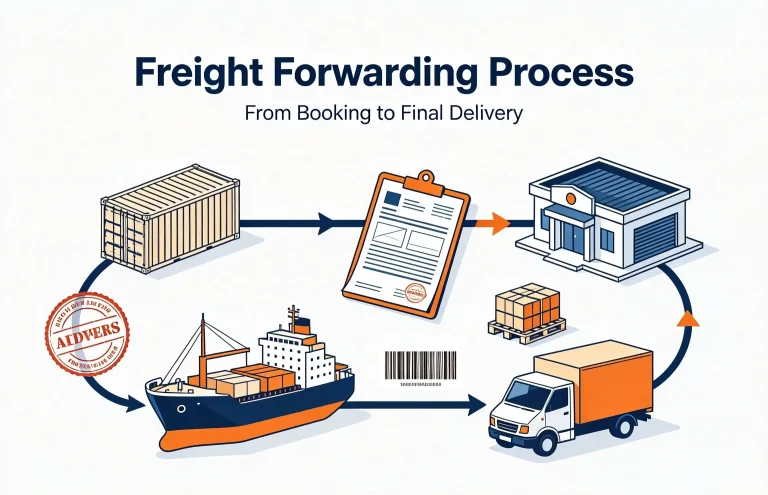
Supplier → Pickup → Consolidation, if required → Cargo preparation → China export → Sea or air freight → Australian customs and biosecurity processes → Warehouse, if required → Final delivery.
Some preparation and clearance work can occur in parallel. The sequence is a planning overview, not a promise that every consignment follows identical steps.
Choose sea freight, air freight or a split plan around the required arrival window and confirmed packed cargo. When comparing LCL and FCL, consider volume, weight, handling, compatibility and destination costs together. Avoid selecting a mode from a single CBM threshold.
For the wider process, read the China to Australia Shipping Guide. If stock needs storage or staged distribution after arrival, include Australian warehousing and fulfilment in the original plan.
Austone supports supplier pickup, consolidation, freight, customs coordination, Australian warehousing and final delivery planning. Its 20,000+ m² Australia Warehouse Network supports the Australia-side discussion; confirm the suitable location, handling scope and availability for your cargo.
Before You Leave Canton Fair: Australian Buyer Checklist
- ☐ Supplier company and reliable contact saved
- ☐ Factory or pickup address and city confirmed
- ☐ Product specification, model/SKU and sample reference recorded
- ☐ Materials or fabric composition identified
- ☐ MOQ, quantities and commercial terms recorded
- ☐ Packing method and photos requested
- ☐ Packed dimensions, weight and estimated CBM obtained or assigned a follow-up date
- ☐ Cargo-ready date and supplier update contact recorded
- ☐ Relevant compliance information collected for review
- ☐ Australian delivery address, postcode and receiving requirements recorded
- ☐ Outstanding questions assigned to someone on your team
If you’re buying from several suppliers, create one supplier list before leaving Guangzhou. Review it with your purchasing and logistics contacts while the conversations are still fresh.
FAQ
When is Canton Fair 2026?
The 140th autumn session runs on 15–19 October, 23–27 October and 31 October–4 November 2026. See the official dates.
Where is Canton Fair held?
At the China Import and Export Fair Complex in Guangzhou, China. The address is 382 Yuejiang Zhong Road, Haizhu District, as listed in the official overview linked above.
Which Canton Fair phase has lighting?
Lighting Equipment is in Phase 1, on 15–19 October 2026.
Which phase has furniture?
Furniture is in Phase 2, on 23–27 October 2026.
Which phase has clothing and textiles?
Phase 3, on 31 October–4 November 2026, includes clothing, sportswear, fabrics and home textiles.
Can Australian buyers attend Canton Fair?
Australian business buyers can attend as overseas buyers, subject to the organiser’s current registration and badge requirements and applicable China entry requirements. Use the official overseas buyer guide to prepare.
What should I ask a Chinese supplier before ordering?
Ask for the exact product specification, materials, MOQ, commercial terms, pickup location, packed dimensions, weight, ready date and relevant documents. Record what still needs confirmation before committing.
Can orders from multiple Chinese suppliers be consolidated?
Yes, when the goods, locations, timing and handling requirements make consolidation workable. Compare the combined plan with separate or split shipments, including pickup, storage and destination costs.
How do I ship Canton Fair purchases to Australia?
Confirm supplier and cargo details, arrange collection and any consolidation, prepare documents and packing, then plan freight, Australian import processes and delivery. Use the process section above to assign each handover.
What should I check before importing into Australia?
Check customs information, applicable biosecurity conditions, packaging, product compliance and delivery requirements. The exact checks depend on the goods; involve your broker and relevant compliance specialists before shipment.
Coming to Canton Fair from Australia?
Already found a supplier—or planning to buy from several?
Tell us what you’re sourcing and where it’s going in Australia. If you already know your supplier locations or cargo-ready dates, send those too.
How Austone supports your shipping plan
We support your international cargo with a clear plan: route and mode advice, document and customs support, then arrival and delivery coordination.
- PlanRoute, mode and timing based on your cargo and deadline.
- ClearDocuments, customs and release coordinated around your shipment requirements.
- DeliverArrival, warehouse and final-mile visibility after the vessel or flight.
Get a shipping quote
Tell us the cargo, route and deadline. We will reply with a clear next step.