RCM vs SAA for Lighting Imports into Australia: What Importers Need to Know
CM vs SAA for Lighting Imports into Australia: What Importers Need to Know
CM vs SAA for Lighting Imports into Australia: What Importers Need to Know
RCM is the regulatory compliance mark applied under Australia’s Electrical Equipment Safety System (EESS) and ACMA compliance frameworks. An “SAA certificate” generally refers to electrical-safety certification issued by SAA Approvals, a recognised certification body under Australian electrical-safety schemes; it is not the RCM, and holding the certificate alone does not complete all Responsible Supplier, equipment-registration and marking obligations that may apply. For in-scope lighting, the Australian or New Zealand Responsible Supplier must meet the applicable registration requirements, and Level 2 or Level 3 equipment must be registered before supply. The RCM must also be applied in accordance with the applicable requirements. Requirements vary by voltage, equipment classification, responsible supplier status and the specific state or territory rules.
Why Lighting Compliance Should Be Checked Before Shipping
Electrical compliance is not a China-side document exercise. Under the EESS, responsibility for in-scope electrical equipment sits with the Australian or New Zealand responsible supplier who brings the equipment into the market. A factory test certificate or a customs declaration on its own does not complete the picture.
For an importer, the practical reasons to check compliance before shipment are straightforward:
- The responsible supplier and equipment registration must exist before in-scope mains-powered lighting is offered for sale.
- Fixing a missing registration, wrong marking or missing test evidence after arrival is slower and costlier than resolving it before departure.
- Customs clearance and electrical compliance are separate checks. Both should be confirmed before the container is booked.
- Non-compliant supply can lead to enforcement action, but the specific consequences depend on the regulator, the product and the circumstances; do not rely on generic fines or detention claims.
What Is the RCM?
The Regulatory Compliance Mark (RCM) is a compliance mark used to indicate that electrical equipment is linked to a responsible supplier under the EESS and, where applicable, to the ACMA labelling framework. Under the EESS, the RCM is the symbol used to show the equipment is linked to a responsible supplier, and the authorisation to apply it resides with that responsible supplier.
There is no standalone “RCM certificate”. The RCM is not a laboratory test report. The compliance evidence sits in the test reports, responsible supplier declarations, equipment registrations and the RCM applied in accordance with AS/NZS 4417.1 and AS/NZS 4417.2.
The RCM replaced the former C-Tick and A-Tick compliance marks following a three-year transition period that ended in February 2016.
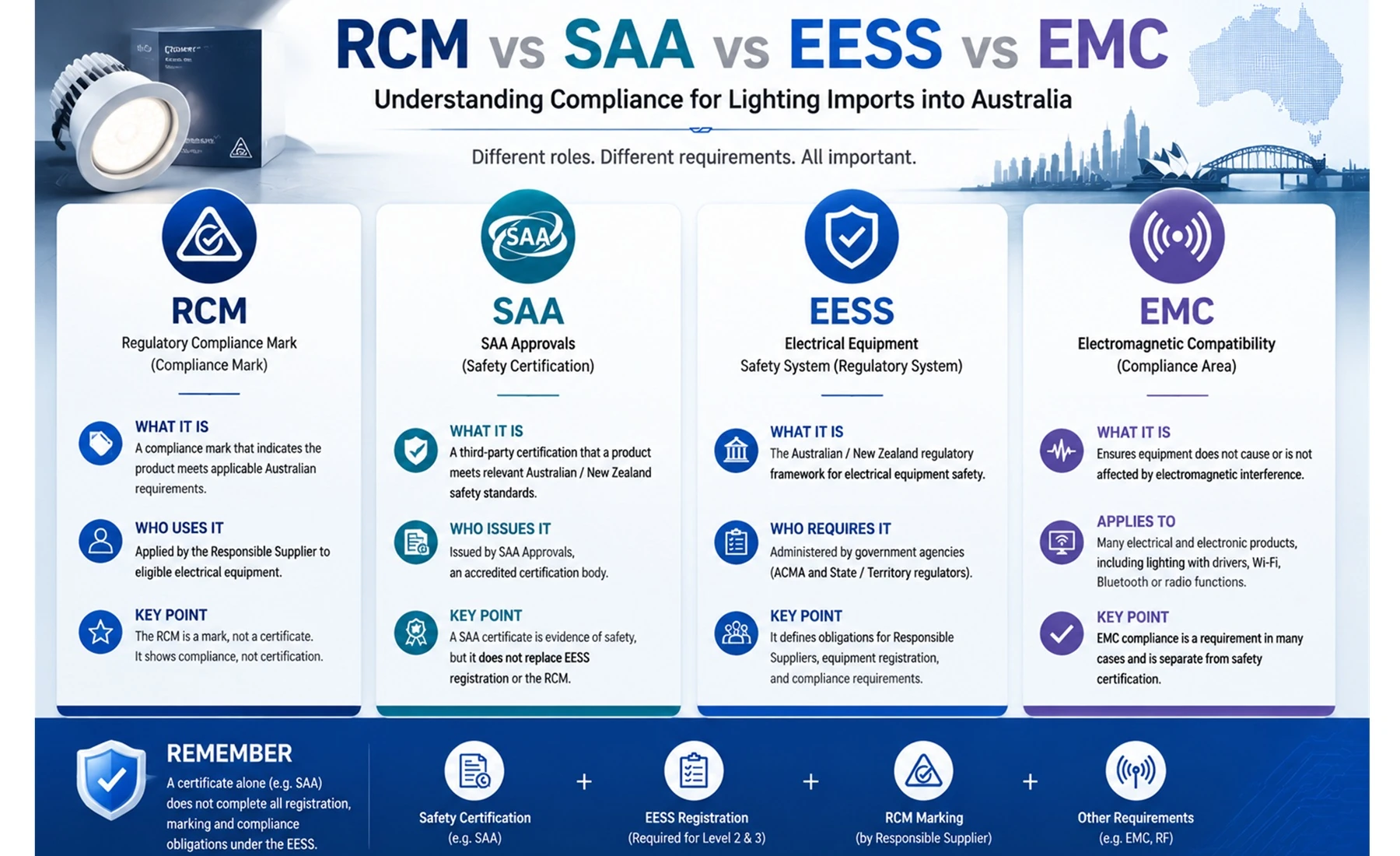
RCM vs SAA vs EESS vs EMC
| What it is | Administered by | Certificate or mark | Key point for importers | |
|---|---|---|---|---|
| RCM | Regulatory compliance mark linked to a responsible supplier | EESS and ACMA frameworks | Mark | Applied after responsible supplier registration and compliance declarations; not a test certificate |
| SAA | Electrical-safety certification issued by SAA Approvals, a recognised certification body under Australian electrical-safety schemes | SAA Approvals / certification body | Certificate (may be a Certificate of Conformity or another recognised certificate) | Not the RCM; holding the certificate alone does not complete Responsible Supplier, equipment-registration and marking obligations |
| EESS | Electrical equipment safety scheme | Australian states and territories through ERAC / participating regulators | System / registration | Responsible supplier registration plus mandatory equipment registration for Level 2 and 3 products |
| EMC | Electromagnetic compatibility requirements | ACMA | Compliance area | Test evidence and declarations; may be covered by the RCM where the labelling notice applies |
What the Australian Importer / Responsible Supplier Needs to Do
Confirm the ABN and legal entity
Under the EESS, a Responsible Supplier must be an Australian or New Zealand legal entity holding an ABN, or a New Zealand IRD number, with a business presence in Australia or New Zealand. An overseas-based company cannot register as a Responsible Supplier in the EESS; it must work through an Australian/NZ Responsible Supplier or establish an Australian/NZ entity.
The EESS ABN requirement applies to Responsible Supplier registration and is separate from ABF customs importer identification. For customs declarations, confirm the current ABF requirement for your specific importer or consignee structure; ABF permits other importer identification where applicable (for example, a Customs Client Identifier or CCID), so do not assume every commercial import requires an ABN for customs clearance.
Register as Responsible Supplier
The Responsible Supplier must register in the EESS Registration Database, make the Responsible Supplier Declaration, and nominate an Authorised Officer. The same database is jointly used by the ACMA and the participating EESS jurisdictions.
Register the equipment
Registration of Level 1 equipment is voluntary. Registration of Level 2 and Level 3 equipment is mandatory. For Level 3 equipment, the Responsible Supplier must hold a current Certificate of Conformity issued by a recognised certifier and listed on the National Register, then register the equipment on the database.
Apply the RCM correctly
All Level 1, 2 and 3 in-scope equipment offered for sale by registered Responsible Suppliers must be marked with the RCM in accordance with AS/NZS 4417.1 and AS/NZS 4417.2. Whether the mark also needs to appear on the outer packaging depends on the applicable standard and labelling notice; confirm this for the specific product.
Keep records
Keep the test reports, declarations, Certificate of Conformity where applicable, registration details and marking records available for inspection.
Jurisdiction note: Electrical-equipment safety regulation in Australia is state and territory based. The EESS applies in participating jurisdictions, while other jurisdictions may operate their own electrical-equipment safety arrangements. Importers should confirm the requirements applicable where the equipment will be supplied.
Are All Lighting Products Treated the Same Way?
No. The obligations depend on whether the product is in scope, its risk level, the voltage supplied, and whether it also falls under ACMA EMC or radiocommunications requirements.
Mains-Powered Lighting
Mains-powered lighting must be checked against the current EESS/ERAC equipment definitions for the specific product. The risk level cannot be determined from “mains-powered lighting” alone. Some lighting equipment may be Level 3, while other luminaires or components may fall under a different risk level.
Where a lighting product is classified as Level 3, a current Certificate of Conformity from a recognised certifier and mandatory equipment registration are required in participating EESS jurisdictions. The luminaire safety standard family relevant to these products is AS/NZS 60598.
Low-Voltage Lighting
Electrical equipment operating below the EESS extra-low-voltage threshold is generally not in-scope under EESS electrical-safety registration, but the complete configuration – including any mains-powered driver or power supply – must be assessed separately. Other safety and ACMA obligations may still apply. Confirm the current threshold and scope definitions for the specific configuration.
Smart Lighting with Wi-Fi / Bluetooth
Smart lighting with Wi-Fi or Bluetooth adds ACMA radiocommunications labelling requirements where applicable, in addition to EMC requirements. Confirm the current ACMA labelling notice and the responsible supplier registration route for the specific product before shipment.
Pre-Shipment Compliance Checklist
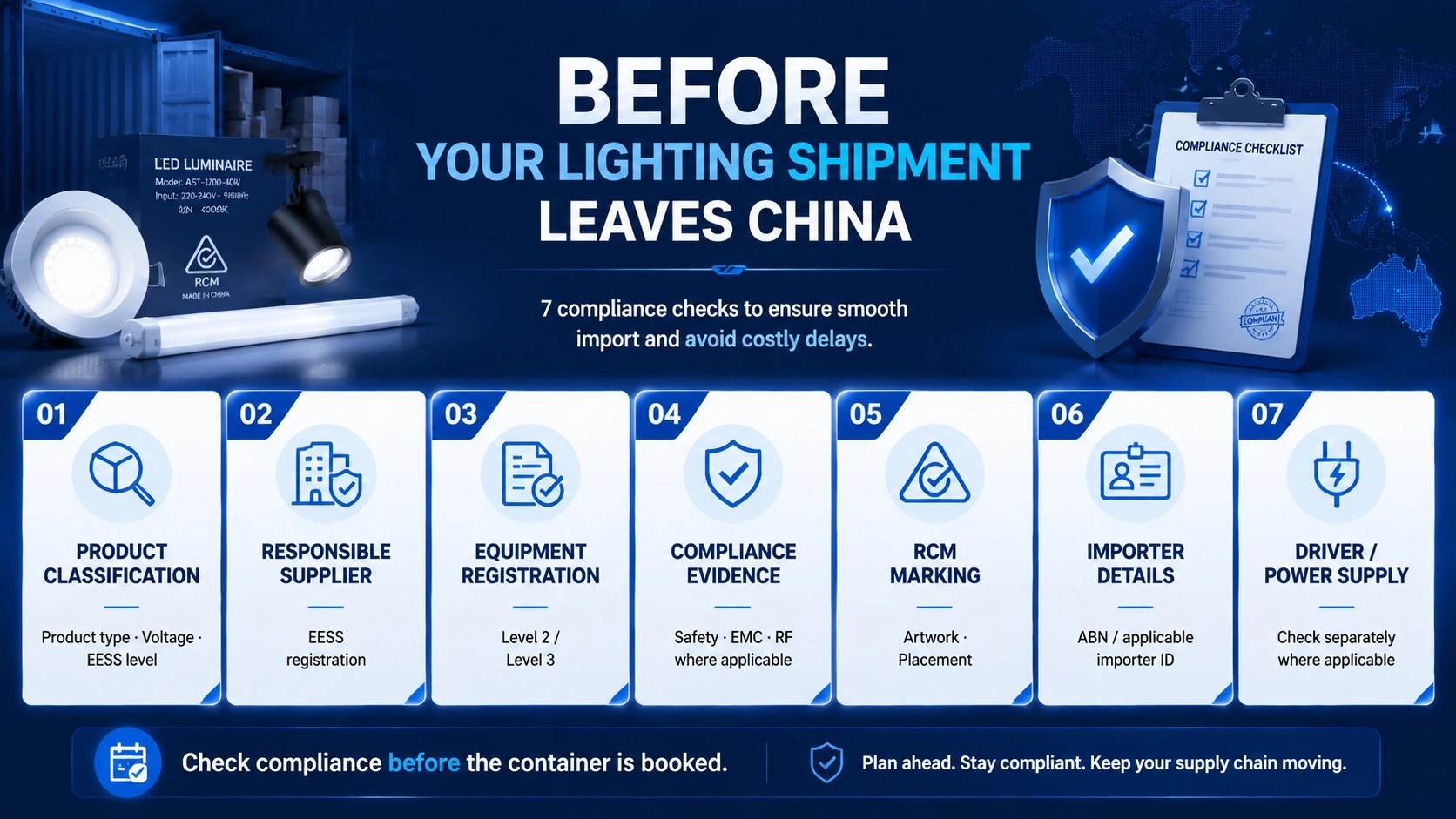
- Confirm the product type, voltage and applicable EESS level classification for each model.
- Confirm the Australian responsible supplier is registered on the EESS database.
- Confirm Level 2 and Level 3 models are registered; for Level 3, confirm a current Certificate of Conformity from a recognised certifier.
- Confirm safety test evidence (e.g., to the relevant AS/NZS 60598 luminaire standard), EMC test evidence and, for smart lighting, RF evidence where applicable.
- Confirm the RCM artwork and placement comply with AS/NZS 4417.1/4417.2, including packaging where required.
- Confirm the ABN or other importer identifier used for customs declarations.
- For low-voltage products, check the mains-powered driver/power supply separately.
Common Compliance Mistakes
- Treating an SAA certificate as the complete market-access approval.
- Assuming the overseas factory can register as the Australian Responsible Supplier.
- Assuming every 12V/24V product is fully exempt because the luminaire is extra-low voltage, while ignoring the mains-powered driver or power supply.
- Marking the RCM before the responsible supplier and equipment registration exist.
- Missing RF requirements for Wi-Fi or Bluetooth smart lighting.
- Confusing customs clearance with electrical compliance; both need separate checks.
FAQ
Q: Is an SAA certificate enough to sell lighting in Australia?
No. An “SAA certificate” generally refers to electrical-safety certification issued by SAA Approvals, a recognised certification body under Australian electrical-safety schemes. Depending on the equipment and certification pathway, the certificate may be a Certificate of Conformity or another recognised certificate. It is not the RCM, and holding the certificate alone does not complete all Responsible Supplier, equipment-registration and marking obligations that may apply.
Q: Who can be the Responsible Supplier?
An Australian or New Zealand legal entity holding an ABN, or a New Zealand IRD number, with a business presence in Australia or New Zealand. An overseas company cannot register directly under the EESS.
Q: Does the Australian consignee always need an ABN?
For EESS Responsible Supplier registration, an ABN or New Zealand IRD number is required by law. This is separate from ABF customs importer identification; for customs declarations, confirm the current requirement for your specific importer or consignee structure.
Q: Do 12V/24V low-voltage lights need the RCM?
It depends. The extra-low-voltage luminaire may fall outside the EESS safety scope, but a mains-powered driver or power supply is separately regulated, and EMC may still apply. Confirm the specific configuration.
Q: What does Level 3 mean?
Level 3 is the higher-risk category for in-scope electrical equipment under the EESS. It requires a registered responsible supplier, a current Certificate of Conformity from a recognised certifier, mandatory equipment registration and correct RCM marking.
How Austone Supports China-to-Australia Lighting Shipments
Austone is a logistics and supply-chain partner, not a certification body, electrical compliance authority or legal adviser. From our operational perspective, the useful checks happen before the container is booked: confirming the Australian importer/consignee details and, where applicable, the Responsible Supplier status, reviewing the product documentation against destination requirements, and flagging missing registration, test evidence or marking before departure.
This is especially relevant for lighting because the compliance picture can change by product type: mains-powered, low-voltage and smart lighting each need a different set of checks.
If you are sourcing lighting from China, our sourcing and inspection support and the lighting industry page are useful starting points for the supplier and freight side.
For freight and documentation support on your next lighting shipment, contact Austone – we can help coordinate the logistics and clearance side while your certifier or compliance adviser confirms the electrical requirements.
Related Case Studies
Need Help With Your Supply Chain?
Speak with Austone specialists about your logistics requirements.