Solid Wood vs Plywood: A Buyer’s Guide to Telling Them Apart (Even When Painted)
Paint, stain, oil or varnish does not determine whether a product is made from solid wood or plywood. One of the most useful checks is the cross-section: solid wood shows one continuous timber structure, while plywood sh…
Guide Overview
- Main Topics
- Process, Documents, Costs, Customs
Paint, stain, oil or varnish does not determine whether a product is made from solid wood or plywood. One of the most useful checks is the cross-section: solid wood shows one continuous timber structure, while plywood shows multiple bonded veneer layers. Grain continuity and hidden surfaces provide supporting evidence. For importers, confirming the material matters before booking, not only for product quality but also for accurate descriptions, customs classification and biosecurity preparation.
The Misconception That Costs Buyers Money
A surprising number of overseas buyers believe that if a piece of wood has been painted, stained, or oiled, it can’t be solid wood – it must be plywood.
This is false, and it’s worth correcting clearly:
Paint, varnish, and oil finishes are surface treatments only. They protect wood from moisture, scratches, and UV damage. They do not – and cannot – change the internal structure of the material underneath.
In fact, solid wood furniture is often finished with some kind of coating, because raw, unfinished solid wood is prone to cracking, warping, and staining. The presence of paint tells you nothing about whether a board is solid or laminated. Below are four ways to check that actually work, regardless of how the surface is finished.
Method 1: Check the Cross-Section (Most Reliable)
This is usually the clearest visual check available, because paint can cover a surface, but it cannot hide what’s inside.
Solid wood: One continuous piece of natural timber. Growth rings and wood grain run through the entire thickness of the board. There are no separate layers and no glue lines inside – even on a fully painted piece, a cut edge reveals a single, integrated wood structure.
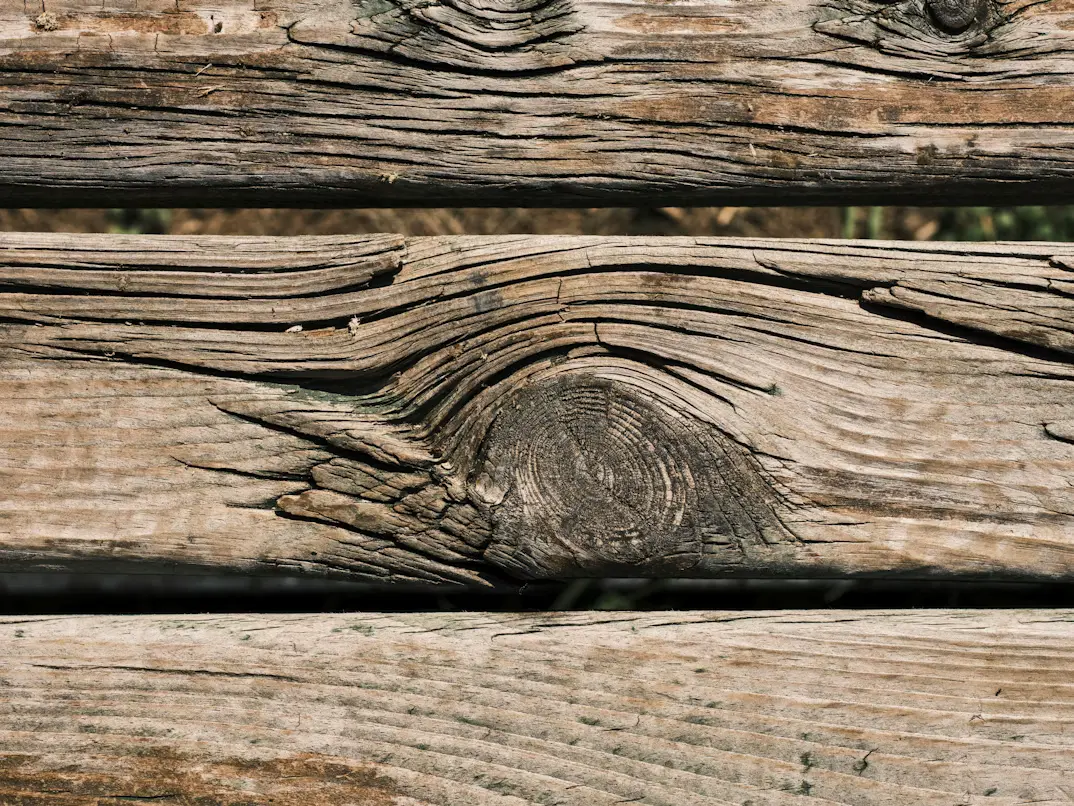
Plywood / 3-ply board: Built from three or more thin wood veneers, stacked with the grain running crosswise and glued under pressure. Cut edges show clear parallel layers and visible glue lines – a structure paint can never fully disguise.

The logic in one line: paint sits on the surface; the internal structure – one solid mass vs. stacked layers – stays exactly what it was.
Method 2: Follow the Grain Around the Edge
No tools needed – just look closely.
- Solid wood: Grain flows continuously from the top face, around the edge, and down the side, as if the whole piece were cut from a single tree trunk. Front, back, and side grain patterns visibly connect, even under a full coat of paint.
- Plywood: Only the outer veneer carries visible grain. At the edge, the grain breaks sharply, and inner layers run in completely different directions. Front and back grain never line up.

Method 3: Weight and Sound
- Weight: For the same dimensions, solid hardwood is noticeably denser and heavier. Plywood, built from thin veneers, feels lighter and slightly hollow.
- Knock test: Tap the surface. Solid wood produces a deep, resonant, “warm” sound. Plywood produces a flatter, duller, thinner thud.
Treat weight and sound as supporting clues, not conclusive tests. Timber species, moisture content, plywood core and internal construction all vary.
Method 4: Check the Hidden Surfaces
Manufacturers cut corners where buyers don’t look.
- Solid wood furniture: The components that are actually solid wood show natural grain and growth rings on visible and hidden surfaces. Furniture may also mix materials: a solid-wood frame can have plywood drawer bottoms, MDF panels or veneered backs. Check component by component instead of assuming the whole piece is one material.
- Plywood products: Decorative veneer usually only appears on visible front faces. Hidden panels (drawer bottoms, backs) are often cheap, unfinished plywood with no attempt at grain matching.
Quick Comparison Table
| Feature | Solid Wood | Plywood / 3-ply Board |
|---|---|---|
| Cross-section | One integrated piece, visible growth rings | Multiple layers with visible glue lines |
| Grain | Continuous across all surfaces | Only on outer veneer; breaks at edges |
| Paint/finish | Standard protective process – doesn’t change material | Also common – decorates surface only |
| Durability | Can be sanded and refinished many times | Thin veneer limits sanding |
| Weight | Heavy, dense | Lighter, hollow feel |
FAQ
Q: If a piece of wood is painted, does that mean it’s plywood?
No. Paint is a protective and decorative finish applied to both solid wood and plywood. It never changes what’s underneath. A more reliable way to check is the cross-section, grain continuity, weight, or hidden panels – not the coating.
Q: Can plywood be painted too?
Yes – painting or laminating is common on plywood as well. That’s exactly why coating alone is not a valid test of material.
Q: What’s the fastest single test if I only have one chance?
Look at a cut edge or hidden corner. If you see parallel layers and glue lines, it’s plywood. If you see one continuous piece of wood grain, it’s solid.
Q: Do all wooden products imported into Australia require ISPM 15 treatment?
No. ISPM 15 applies to specified raw solid-wood packaging materials such as pallets, crates and dunnage. The wooden product itself has its own product-specific biosecurity conditions, which should be checked through BICON before shipment.
Why Getting This Right Matters When Importing
Material identification isn’t just a quality question – it directly affects how a shipment is described, documented, and cleared:
- Customs classification – The material can be relevant to classification, but finished products are classified according to the applicable tariff rules for the complete article. Accurate material descriptions help the customs broker assess the correct classification.
- Biosecurity and quarantine – whether a wooden product needs treatment, a permit, or inspection is product-specific and determined through Australia’s Biosecurity Import Conditions system (BICON). ISPM 15 applies separately to solid-wood packaging material, not automatically to every wooden commodity.
- Documentation accuracy – a vague description like “wood board” invites customs queries and delays. A precise one – “solid pine timber panel, kiln-dried, painted surface” – moves through clearance far more smoothly.
Before shipping, it’s worth confirming with your supplier: timber type, processing method, intended use, and country of origin. These details give the customs broker a stronger starting point for assessing the product, although additional information may be required depending on the goods.
Keep ISPM 15 and Product Biosecurity Separate
ISPM 15 regulates raw solid-wood packaging material used in international trade – pallets, crates, dunnage, blocks and skids. It does not automatically apply to the wooden product itself. Packaging made wholly from processed wood materials such as plywood, particleboard, oriented strand board or veneer is generally outside the ISPM 15 provisions described by the Australian Department of Agriculture, Fisheries and Forestry (DAFF).
The goods themselves are a separate check. DAFF requires imported timber, wooden articles, bamboo and related products to meet the conditions in BICON, which vary by product, components, manufacturing process, bark status and intended use. Check the current BICON pathway for the specific product before shipping, and confirm the same for the packaging.
Regulatory verification
Regulatory human verification has now been completed against current official Australian DAFF and BICON sources. The following regulatory conclusions are approved:
- Timber/wooden commodities and wood packaging must be treated as separate biosecurity questions.
- Imported timber and wooden articles must meet the applicable product-specific BICON import conditions.
- ISPM 15 applies to relevant raw solid-wood packaging material; it is not a universal requirement for every wooden commodity.
- Packaging made wholly from sufficiently processed plywood, particleboard, OSB or veneer is generally outside ISPM 15 requirements, subject to the applicable DAFF packaging conditions.
- Do not infer that a painted or surface-finished wooden product is automatically exempt from product-specific biosecurity requirements.
Official references:
- Importing timber, wooden articles, bamboo and related products – DAFF
- Types of timber, bamboo and related products – DAFF
- ISPM 15 and solid wood packaging material – DAFF
A Real Austone Case: Painted Wooden Toys Identified Before Shipment
A real shipment handled by our team shows why surface appearance should never be used as the only way to judge a timber product.
In May 2024, Austone was handling a shipment for a toy customer that included painted wooden building blocks.
Because the blocks had been painted and appeared to be processed finished products, the customer believed the timber no longer needed the same treatment consideration as exposed solid wood.
However, when the cargo arrived at our warehouse, our team inspected the goods and identified that the underlying material was solid wood.
That changed the pre-shipment compliance planning.
Rather than relying on the painted surface or the product description alone, we informed the customer of the material-related clearance risk and arranged the required treatment and supporting documentation before shipment.
Had the issue only been discovered after arrival at destination, the shipment could have faced additional inspection, treatment, storage or clearance delays.
By identifying the material before departure, the treatment was arranged before shipment and the cargo avoided that preventable destination-clearance risk.
What Importers Can Learn From This Case
The important lesson is simple:
Surface treatment does not necessarily change the underlying timber material.
Paint, fabric covering or other finishing may make a product look highly processed, but importers still need to confirm what the product is actually made from.
For timber-containing products, Austone’s operational practice is to check:
- What is the underlying material?
- Is it solid timber, plywood or another engineered wood product?
- How has the timber been processed?
- What documentation or treatment may apply to the specific product and destination?
- Does the commercial invoice describe the material accurately?
These checks are best completed before booking and departure, not after the cargo reaches the destination.
How Austone Helps Check Timber-Related Risks Before Shipping
For timber and timber-containing products, the useful work often happens before the container is booked.
Austone can coordinate with the customer, supplier and operations team to confirm the actual material, review cargo descriptions and supporting documents, and identify potential treatment or clearance issues before departure. This is the same workflow behind the painted toy blocks case above.
This is particularly important when the timber is not immediately visible – for example, painted wooden products, upholstered furniture with internal timber frames, or products containing a mix of solid wood and engineered board. For shipments to Australia, customs clearance coordination is where product descriptions and supporting documents should be reviewed before departure.
Where destination requirements need specialist confirmation, the applicable biosecurity and customs requirements should be checked against the current rules for the specific product before shipment.
The objective is straightforward: identify material and documentation issues in China, where they are usually easier to correct, rather than after the cargo has reached the destination. If you are shipping timber products from China to Australia, contact Austone for a shipment-specific review before you book.
How Austone supports your shipping plan
We support your international cargo with a clear plan: route and mode advice, document and customs support, then arrival and delivery coordination.
- PlanRoute, mode and timing based on your cargo and deadline.
- ClearDocuments, customs and release coordinated around your shipment requirements.
- DeliverArrival, warehouse and final-mile visibility after the vessel or flight.
Get a shipping quote
Tell us the cargo, route and deadline. We will reply with a clear next step.